Custom Packaging Printing in Toronto: How to Spec and Order
October 2, 2026
Booklet Binding in Toronto: Saddle Stitch or Perfect Bound
November 13, 2026
A-Frame Signs in Toronto: Which Rigid Board to Print On
An A-frame sign is the smallest piece of storefront marketing most Toronto retailers and restaurants buy, and the one that fails first. The frame outlives everything; what curls, fades, cracks at the hinge or blows down the sidewalk is the printed board inside it. Choosing that board is the whole decision, and it is made before anyone opens the artwork.
C17 Media prints A-frame and rigid signage direct to substrate on foamboard, gatorboard, sintra, styrene and coroplast, with pre-press, printing, cutting and finishing all done in-house in Richmond Hill. This is how to spec the panel so it is still legible at the end of the campaign.
The short version
- Coroplast, foamboard and gatorboard are the boards for temporary and promotional signage. Sintra and styrene sit closer to fixture work.
- A sign that lives outdoors needs the laminate, the sealed edge and the mounting specified with it, not after it.
- Size the type to the distance people actually read from: roughly 25 mm of cap height for every 3 m of reading distance.
- Print both faces. One side faces the morning traffic, the other faces the afternoon.
- For a chain, the panel is the consumable and the frame is the fixture: reprint panels per campaign, keep the stands.
What a sidewalk sign has to survive
An A-frame on a Toronto sidewalk lives outdoors in the worst way: no shelter, direct sun on one face, and everything the street throws at it. The forces that matter out there are freeze-thaw cycles, road salt and direct UV. Against them, substrate selection, laminate, edge sealing and mounting hardware matter more than the graphic itself, and that is where cheap signage visibly fails within two years.
A sidewalk sign adds one force a wall sign never faces: it gets knocked over, picked up, folded, carried inside at close and dropped on a tile floor. Handling is the thing most A-frame panels actually die of. A board that is rigid enough to stay flat in the frame but light enough that staff will keep bringing it in survives longer than a stiffer board nobody wants to lift.
The boards C17 Media prints, and where each one belongs
C17 Media prints direct to substrate rather than printing on vinyl and mounting it, which is why the board is specified first. The shop’s own rule is to specify against the environment rather than defaulting to whatever is cheapest to quote. Here is what each board is and where C17 puts it.
| Board | What it is | Where it belongs |
|---|---|---|
| Coroplast | Corrugated plastic sheet with fluted ribs running one way | Temporary, promotional and construction signage. The default A-frame insert for a campaign measured in weeks. |
| Foamboard | Foam core between two paper or plastic faces | Indoor promotional work where the finish is read close up: counter units, headers, standees. |
| Gatorboard | Foam core with a hard wood-fibre veneer face | Promotional signage that gets handled: stiffer and more dent-resistant than plain foamboard. |
| Sintra | Expanded rigid PVC sheet | Interior signage seen at arm’s length, and display fixtures meant to live on the floor for a year or more. |
| Styrene | Thin, light rigid plastic sheet | Short-run promotional panels and inserts where weight and cost matter more than stiffness. |
| Aluminum and ACM | Solid aluminum, or an aluminum composite panel | Exterior signage that stays outside through an Ontario winter, with UV laminate and sealed edges. |
The line that matters for an A-frame runs between row one and row six. A coroplast insert is a consumable: print it, run the promotion, retire it, print the next one. An aluminum or ACM panel is a fixture that stays in the frame for years and gets specified with a UV laminate and sealed edges because it is going to take the weather. Deciding which one you are buying — a consumable or a fixture — settles the material, the finishing and the reorder plan in one go. Full substrate options are on the custom signage page.
How big the type has to be
Most sidewalk signs fail as signs long before they fail as objects. They carry six lines of small type that nobody reads at walking speed. Sign-legibility research for on-premise signs sets a conservative floor: a legibility index of one inch of letter height for every 10 feet of reading distance, about 25 mm for every 3 m (Garvey and Klena, Interdisciplinary Journal of Signage and Wayfinding, 2020).
Minimum cap height
How tall the letters have to be to be read
At a legibility index of 25 mm of capital-letter height per 3 m of reading distance. A shopper walking past a sidewalk sign is usually reading from 3 to 6 m.
Read from 3 m (10 ft)
25 mm
Read from 6 m (20 ft)
50 mm
Read from 9 m (30 ft)
75 mm
Read from 12 m (40 ft)
100 mm
Work backwards from the sidewalk. If the sign sits beside the door and people read it from 3 m, 25 mm capitals are the floor and 40 mm is comfortable. If it is out at the curb of a plaza and the reader is 9 m away in a car, the headline needs 75 mm and the sign can only carry three or four words. One message per face, large, beats five messages nobody stops for.
Laminate, sealed edges and the Ontario winter
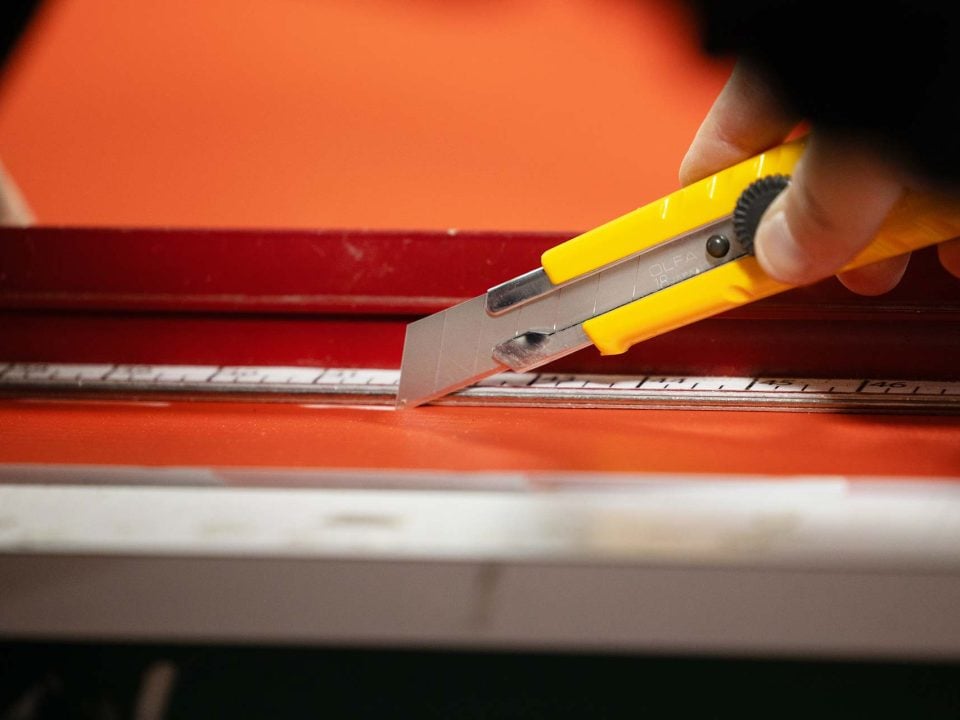
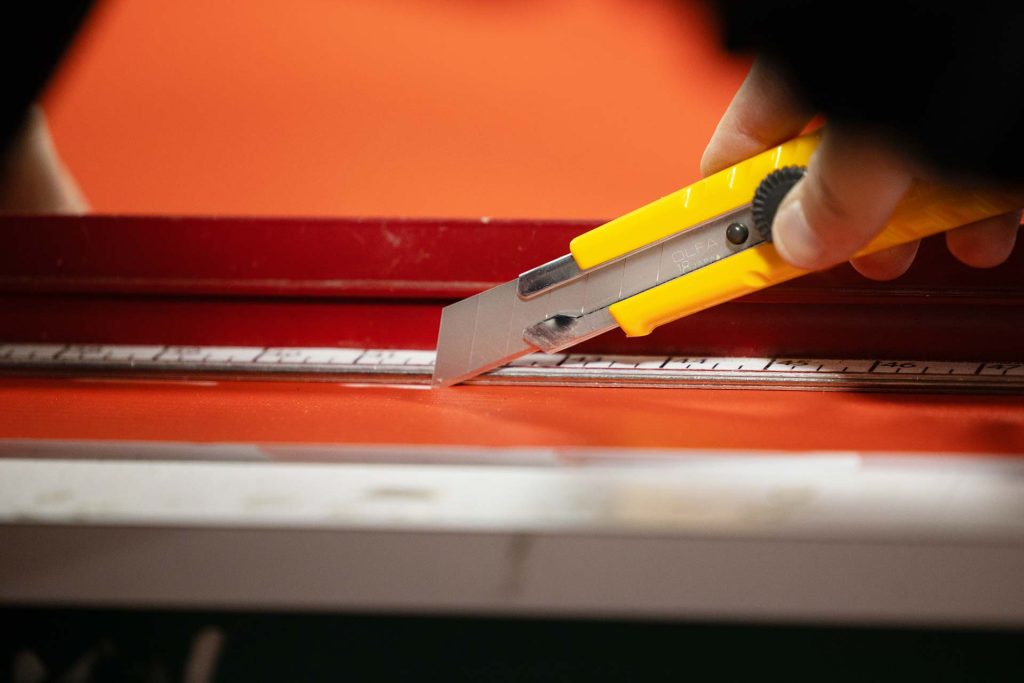
Print is only half a finished exterior panel. The laminate carries the UV load so the ink does not, and a sealed edge keeps water out of the board’s core, which is where freeze-thaw damage starts. On a corrugated board, water that gets into the flutes and freezes will separate the faces. That is why C17 Media specifies the laminate and the edge treatment with the substrate rather than treating them as an upsell.
Mounting is the other half. A board is only as fixed as its hardware: grommets, through-bolts, hinges and a frame that holds the panel at all four edges rather than two. A sign that spends its winters indoors overnight and its summers on the sidewalk can run on a lighter spec than one left out year-round. Decide that before the quote, because it changes the board.
Print both faces, and keep the frame
An A-frame has two faces and most buyers only use one of them. The second face is a second audience — the other direction of foot traffic — and it does not have to repeat the first. Morning side: the breakfast offer. Afternoon side: the thing people buy at four o’clock. For a retailer, one face can hold the campaign and the other the thing that is always true — the hours, the service, the fact that you are open during construction.
Treat the stand as a fixture and the printed panel as a consumable. Reprinting the inserts each quarter is how a storefront stays current without anyone replacing the hardware. C17 Media keeps your specification on file after a job, so a replacement panel two years later matches the one already in the frame rather than being visibly newer. The same logic runs through POP displays and window graphics: swap the graphic, keep the structure.
The same sign at every location
One A-frame is a simple job. Forty A-frames that have to look identical at forty restaurants is a production problem, and it is where chains lose the plot: three suppliers, three reds, three board thicknesses, and a brand that looks different at every store.
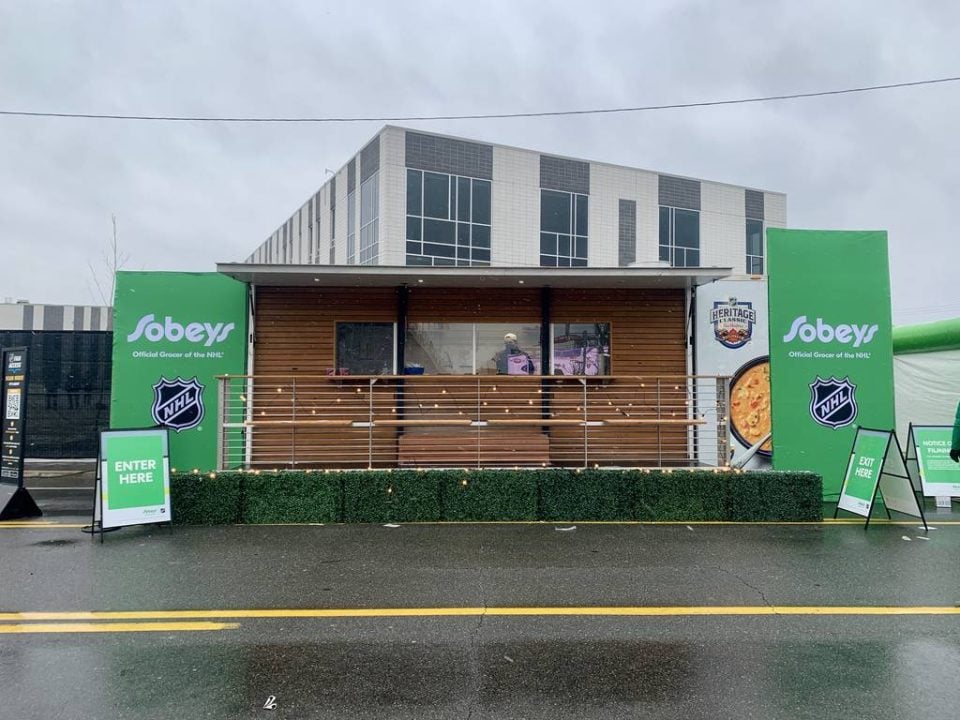
C17 Media runs multi-site signage programs in-house, start to finish: the same substrate, the same colour and the same install standard at every location. Each site is surveyed, the full program is produced together, and installations roll out on a schedule tied to your openings and campaign dates. The shop’s own 3M-certified crews do the installs, including exterior, elevated and multi-site work. For a QSR group running a six-week promotion across the GTA, that is the difference between a launch date and a launch window.
What to send the printer
Rigid signage is unforgiving of thin artwork, because it is printed at the size you stand in front of. Send vector logos and type where you can, supply photography at the size it will be printed rather than scaled up from a web image, and say which face each file belongs to. If the artwork is coming from a brand team elsewhere, send the brand standards too — C17 Media matches substrate, finish and colour against them, and keeps the specification for reorders. C17 Media’s guide to why print files fail covers the rest of the setup.
Simple printed rigid signage is often a matter of days in production. Fabricated work — routed letters, dimensional logos, illuminated faces — takes longer, and exterior installation in winter is weather-dependent. Ask for a firm date at quote stage.
Frequently asked questions
What are A-frame signs made of?
C17 Media prints A-frame and rigid signage direct to substrate on foamboard, gatorboard, sintra, styrene and coroplast. Coroplast is the usual choice for temporary and promotional inserts; exterior panels that stay outside year-round move to aluminum or ACM with a UV laminate and sealed edges.
Will a coroplast A-frame survive a Toronto winter?
Coroplast is specified for temporary and promotional signage, not as a permanent outdoor fixture. Freeze-thaw cycles, road salt and UV are what break exterior signage down, and water in the flutes of a corrugated board is the usual first failure. For a sign that lives outside all year, ask for a weather-rated substrate, a UV laminate and sealed edges.
How tall should the lettering be?
Use about 25 mm of capital-letter height for every 3 m of reading distance as a floor. A sign read from the doorway needs 25 to 40 mm capitals; one read from across a parking lot at 9 m needs 75 mm and can only carry a few words.
Can both faces be printed, and can the panel be cut to a shape?
Yes to both. Both faces can carry different messages, and contour cutting, CNC routing and laser cutting are done in-house, so a panel can be cut to a product silhouette or a logo rather than left as a rectangle.
Can you produce the same sign for every one of our locations?
Yes. Multi-location programs get the same substrate, the same colour and the same install standard at every site. Each location is surveyed, the full program is produced together, and installs roll out on a schedule tied to your openings and campaign dates.
Where does C17 Media do this work?
Printing, routing and finishing happen at 30 West Beaver Creek Rd, Unit #12, Richmond Hill, Ontario, and installs run across Toronto and the GTA. Call 905.597.2178 or use the contact page for a quote.
Spec the board, then the graphic
A sidewalk sign is a small purchase that gets judged at close range by everyone who walks past your door. Decide first whether the panel is a consumable or a fixture, pick the board from that, size the type to the distance people read from, and print both faces. To spec an A-frame or a rigid signage program for a store, a restaurant or a chain, send the details through the signage page or call 905.597.2178.