Booklet Binding in Toronto: Saddle Stitch or Perfect Bound
November 13, 2026
Wayfinding Signage in Toronto: How to Spec a System
November 16, 2026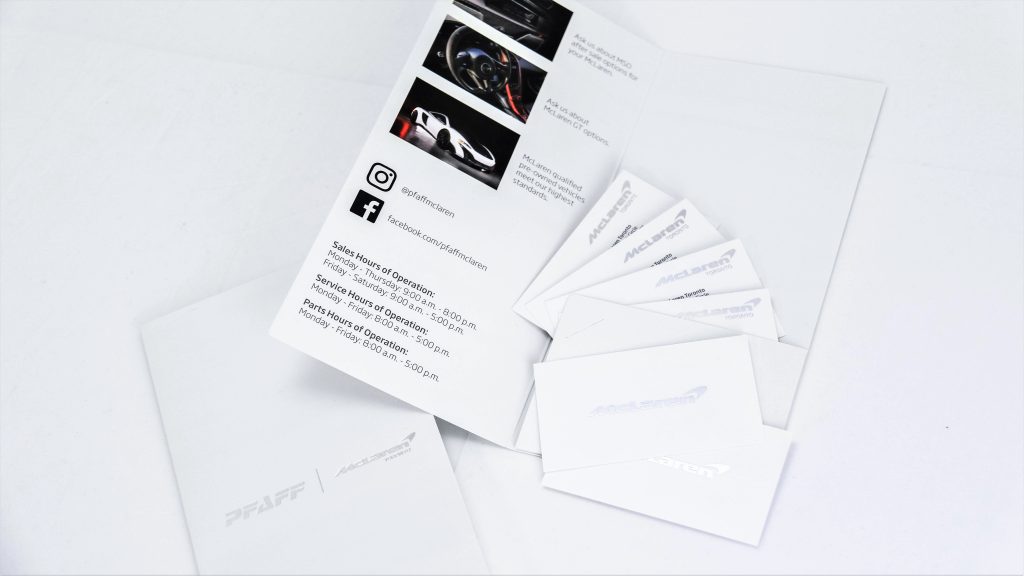
Presentation Folder Printing in Toronto: How to Spec One
A presentation folder is one of the few printed pieces that has to be specified from the inside out. The board, the die and the finish all follow from what is going into it, and the folder jobs that go wrong are almost always the ones where the folder was ordered first and the contents were counted afterwards. By then the pocket is too shallow, the cover will not close over a bound insert, or the corporate blue on the folder does not match the corporate blue on the sell sheet inside it.
C17 Media prints and die-cuts presentation folders in Richmond Hill, on the same digital and offset presses that run the business cards, letterhead and sell sheets a folder usually travels with. This is how to spec one for a sales kit, a franchise onboarding package or a trade-show handout anywhere in Toronto and the GTA, in the order a printer actually needs the decisions.
The short version
- The folder is sized by its contents, not the other way round. Letter inserts want a 9 by 12 inch folder; a bound booklet or a legal sheet wants a larger die.
- Measure the thickness of what goes inside before anything is cut. Past roughly a quarter of an inch, a flat folder stops closing and the spec changes to a reinforced spine.
- Board weight is a handling decision. Twelve point mails well. Fourteen to sixteen point is what holds its shape when the folder is handed over a table.
- Dark solids on coated board show fingerprints and scuff along the pocket edge. A matte or soft-touch laminate is the fix, and it is cheaper than a reprint.
- Every folder is die-cut, so the finishing pass belongs in the schedule from day one rather than being discovered at the end.
What the folder has to do before it has to look good
A folder does three jobs at once, and they pull in slightly different directions. It holds a set of loose sheets together so they arrive in the right order. It survives being carried, handed over, put down on a boardroom table and dropped into a bag. And it presents the brand at the moment someone is deciding whether to keep the contents or recycle them.
The handling part is the one most often skipped at the quote stage, and it is the one that decides stock and finish. A folder that is mailed flat, opened once and filed can be a light board. A folder that sits on a dealer counter for a month, or gets passed around a franchise onboarding session, needs stiffer board and a laminate, because the wear shows up at the pocket edge and on the fold long before the printing fades.
Start with what goes inside
Before the die, before the stock, count the contents. Four things settle most of the spec.
Insert size. Letter sheets at 8.5 by 11 inches are the default. Legal sheets, square formats and bound booklets are not, and each needs a folder cut larger than the stock size so the insert is not fighting the pocket.
Thickness. Add up what actually goes in: sell sheets, a price list, a bound catalogue, a sample card. Past roughly a quarter of an inch of contents, a flat folder stops sitting closed, and the answer is a reinforced spine rather than a deeper pocket. C17 Media cuts folders with reinforced spines for exactly this reason.
What has to stay put. A business card rides in a die-cut slit, not loose in a pocket. A USB, a material chip or a swatch needs its own feature in the die, and that is a drawing decision, not something to improvise once the board is cut.
Whether the inside is printed. Interior printing turns the pocket faces into usable space for a process diagram, a contact list or a QR code. It is a second side on press, so it belongs in the first quote rather than in a change order.
The size that holds a letter insert
The standard two-pocket folder is 9 by 12 inches with pockets around 4 inches deep. Those numbers exist because of the insert: a 9 by 12 inch folder clears an 8.5 by 11 inch sheet on three sides, so pages slide in without catching, and a 4 inch pocket is deep enough that a single loose sheet does not slip out when the folder is tilted.
Folder dimensions at a glance
The four numbers behind a standard pocket folder
What the common trade size is built around, and the board range it is cut from.
9 × 12 in
the usual two-pocket folder size, and the one every stock die is cut to
8.5 × 11 in
the insert it is built around, with clearance so pages do not catch
~4 in
standard pocket depth, deep enough that a loose sheet stays put
12–16 pt
the board range a folder lives in, measured in thousandths of an inch
Anything outside that envelope is a custom die. That is routine work, but it is worth naming early: a custom die is drawn, cut and proofed, and if the folder has to hold a saddle-stitched booklet as well as loose sheets, the drawing is where that gets solved.
Board weight, and why it is quoted in points
Folder board is specified in points, which measures caliper rather than weight. Twelve point board is twelve thousandths of an inch thick; 16 pt is sixteen. Most presentation folders sit in that 12 to 16 pt range, and the choice is about handling, not quality.
Twelve point is the economical choice for a folder that is mailed or inserted into a larger kit, and it keeps postage down when the drop is large. Fourteen point is the middle ground and the safe default. Sixteen point is what you want when the folder is handed to someone across a table, because stiffer board does not bow in the hand, and the pocket holds a thicker set of inserts without splaying. For comparison, C17 Media runs business cards on much heavier 16 pt and 32 pt stocks; a folder stays lighter than a card because it still has to fold cleanly.
Coated or uncoated, and what the folder looks like after a week
Most folder board is coated on one side, so the printed outside takes ink crisply while the inside stays uncoated and can be written on. That is usually the right call for a folder that doubles as a working document in a meeting.
The trap is dark coverage. A folder printed in a deep navy, charcoal or black shows fingerprints immediately, and the pocket edge scuffs where thumbs open it. If the brand palette is dark, plan for a matte or soft-touch laminate from the start. It costs less than a reprint, and it changes how the folder feels in the hand, which is most of the reason for printing one at all.
Finishing that earns its cost on a folder
Folder finishing is not decoration. Each option does something specific, and C17 Media runs all of it in-house in Richmond Hill rather than shipping the job across the city.
Soft-touch laminate with spot UV. A velvet laminate across the whole folder with a high-gloss spot UV on the logo gives a contrast you feel before you see. It works on folders and booklet covers as well as on cards.
Foil stamping. Metallic and matte foils in gold, silver, copper and custom colours. On a folder, a foil strike reads strongest on a dark laminated board, where the metal has something to sit against.
Embossing. Blind or registered, for a raised tactile mark. Blind embossing on an uncoated folder is quiet and works where foil would be too loud.
Two scheduling notes. Foil and embossing need a custom die made for the artwork, and specialty finishing adds two to four days to a standard stationery job. Neither is a surprise if it is in the brief; both are if they arrive after the file is approved.
Dies beyond the standard pocket
The stock shape is only a starting point. Rounded corners, custom silhouettes, cut-through windows and angled pockets are all cut on C17 Media’s own dies, which is what makes a non-standard folder worth asking about rather than designing around.
Three that pull their weight in commercial work: a business card slit on the right pocket, so the card is part of the folder instead of loose in it; a window cut in the cover that shows the first insert, which turns the top sheet into the cover design; and a reinforced spine on a folder built to hold a catalogue, so the finished kit still stacks flat in a box.
Digital or offset: the run length decides
C17 Media runs digital and offset presses side by side, so the recommendation follows the job rather than the equipment.
Digital prints straight from the file with no plates. Setup is fast, short runs stay affordable, and a run of a hundred folders for one pitch or one hiring round is practical. Offset makes physical plates and runs ink through a press: it costs more to set up, drops sharply in per-unit cost at volume, mixes true Pantone spot inks, and prints on a wider range of stocks. For a brand colour that has to be exact across a large run, offset is the answer. The full comparison is in our guide to digital versus offset printing.
One folder, many locations
Brand consistency on folders breaks the same way it breaks on business cards: each branch orders its own from a different shop, and a year later no two match. The production fix is to lock one approved template, merge each location’s variable data, print the whole program in a single run so the colour is identical everywhere, then kit and ship to each address individually.
For a franchise or dealer network, that means one approval and one invoice, with each location receiving its own labelled box. It also means the reorder is a reprint rather than a redesign, because the approved artwork, stocks and Pantone builds are already on file.
Files that print the first time
A folder file is not a page. It is a flat die shape with fold lines, glue tabs and pocket panels, and artwork has to be built on the printer’s template for that specific die.
Three things catch most folder files. Bleed: every edge that gets cut needs art carried an eighth of an inch past the trim, including the curves inside the pocket. Live copy: type and logos placed too near a fold line or over a glue tab either crack on the score or disappear under adhesive. And colour build: artwork supplied in RGB will shift when it is converted, which is why brand colours are supplied as Pantone references or CMYK builds, not as screen values. Our posts on why print files fail and brand colour consistency cover both in more detail.
If the file is not print-ready, in-house pre-press can fix bleed and resolution, convert artwork to a print-ready build, or rebuild a logo that only exists as a low-resolution file.
What to send with a quote request
A folder can be quoted accurately from six lines.
- Insert size and sheet count — letter, legal or booklet, and roughly how many sheets ride in each pocket.
- Total thickness of the contents — the number that decides between a flat folder and a reinforced spine.
- Quantity, and whether it is one drop or several — a single pitch run and a national rollout are different jobs on different presses.
- Stock and finish — or a description of how the folder will be handled, which is enough for us to recommend one.
- Anything that has to be held in place — a business card, a sample chip, a USB, a spec sheet that must not slide out.
- The date it has to be in hand — and whether that date is the delivery or the meeting.
That is enough to come back with a die recommendation, a stock, a finish and a price, and to say whether the job belongs on the digital press or the offset press.
Frequently asked questions
What size is a standard presentation folder?
The usual trade size is 9 by 12 inches with two pockets about 4 inches deep, which holds 8.5 by 11 inch inserts with enough clearance that pages do not catch on the pocket edge. Legal inserts, oversize booklets and square formats need a larger die, and those are cut to the job rather than pulled off a shelf.
What stock weight should a presentation folder be printed on?
Folder board usually sits between 12 pt and 16 pt. Twelve point is light enough to mail economically and is fine for a folder that is opened once. Fourteen to sixteen point holds its shape when the folder is handed across a table or carried loose in a bag. Point measures caliper, not weight, so 16 pt board is sixteen thousandths of an inch thick.
Can a folder hold a thick insert, such as a bound catalogue?
Yes, with a reinforced spine. A flat folder stops closing cleanly once the contents are past roughly a quarter of an inch, and the cover starts to spring open. C17 Media cuts folders with reinforced spines for thicker inserts, which adds depth at the fold so the folder still sits flat when it is full.
How long does presentation folder printing take?
C17 Media publishes three to five business days for standard digital stationery from print-ready file approval, and two to four days on top for specialty finishing such as die-cutting, embossing or foil stamping. A folder is die-cut by definition, so that finishing pass is part of the schedule from the start. Offset runs and large multi-location kits are quoted with a firm date up front.
Is there a minimum order for presentation folders?
There is no meaningful minimum on the digital press, so a short run for one pitch or one hiring round is practical. Where the job becomes cheaper on offset depends on the quantity, the stock and the finishing, and we will tell you where that crossover falls for your spec rather than quietly running it the expensive way.
Can you match the Pantone colours in our brand guidelines on a folder?
On offset, true Pantone spot inks are mixed, which is the most accurate reproduction available. On digital, the colour is matched as closely as the process allows and you see a proof before the full run. C17 Media keeps the approved colour build on file, so a reorder next year matches this year’s folder instead of drifting.
Ordering presentation folders from C17 Media
Send the insert size, the thickness of the contents, the quantity and the date it has to be in hand. See the full corporate stationery printing service for the cards and letterhead a folder usually ships with, the rest of our digital and offset printing work, or get in touch with our Richmond Hill facility at 30 West Beaver Creek Rd, Unit #12.