
Custom Packaging Solutions in Richmond Hill for Every Business
April 15, 2026
Silicone Edge Graphics (SEG): Why Retail Made the Switch
May 18, 2026
Ask five printers to explain digital versus offset and you’ll get five different answers, most of them full of jargon. Here’s the plain-English version. Offset is the classic press method that transfers ink from a plate to a rubber blanket to paper. Digital skips the plates entirely and prints straight onto the sheet. Both produce excellent work. The right choice depends on quantity, timeline, and whether every piece needs to be identical. The stakes are real: Smithers forecasts the global print market will reach $834.3 billion in 2026, with digital’s share by value growing from 17.2% in 2021 to 21.6% in 2026 (Smithers, 2021). This guide walks through how each method works and when we’d honestly recommend one over the other.
Key Takeaways
- Offset transfers ink from plate to blanket to paper; digital prints directly with no plates.
- Offset’s setup cost spreads across long runs, so unit cost falls as quantity grows. Digital’s unit cost stays flat.
- Digital’s share of the global print market is forecast to grow from 17.2% (2021) to 21.6% (2026), per Smithers.
- Digital enables variable data: every single piece can be different.
What Is Offset Printing?
Offset printing, formally offset lithography, works on a principle you learned in grade school: oil and water don’t mix. The image areas of a metal plate accept oily ink and repel water, while the non-image areas do the opposite. The inked image transfers to a rubber blanket, which then “offsets” it onto the paper (PrintWiki).
That indirect transfer is where the name comes from. The plate never touches the paper. Instead, the flexible rubber blanket conforms to the sheet’s surface, laying down clean, consistent ink coverage sheet after sheet, hour after hour.
Why does this centuries-old chemistry still dominate long-run commercial work? Because once the plates are made and the press is dialled in, an offset press produces identical copies at remarkable speed and consistency. It’s a workhorse built for volume, and it remains the backbone of catalogues, magazines, packaging, and large brochure runs across the commercial printing world.
What Is Digital Printing?
Digital printing requires no plates at all. The image travels from file to press and prints directly onto the substrate, which is exactly why it excels at cost-effective short runs and on-demand printing (Xerox).
Think of it like the difference between publishing a book and printing a document at your desk, just at professional scale and quality. There’s no plate-making, no lengthy makeready, no press sheets sacrificed while the operator balances ink and water. You send the file, the press prints it.
That near-zero setup changes the economics completely. Need 50 brochures for tomorrow’s client meeting in downtown Toronto? Digital. Need a proof before committing to a full campaign? Digital. Need version two of a flyer after the offer changed on Tuesday? Digital again. Speed to first sheet is the whole point.
Offset vs. Digital at a Glance
This is the side-by-side comparison we walk clients through. Neither column “wins”; they solve different problems, and most established brands end up using both across a year of print work.
| Offset Printing | Digital Printing | |
|---|---|---|
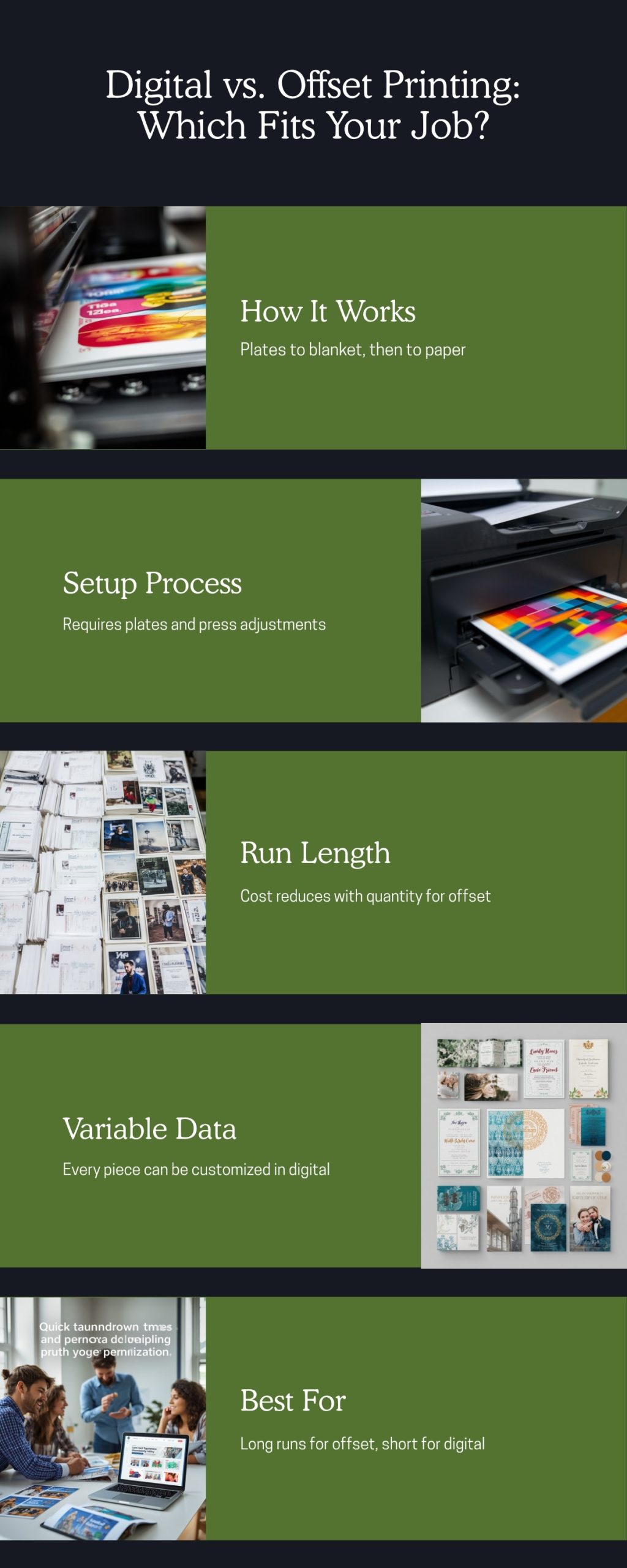
| How it works | Ink transfers from a plate to a rubber blanket, then onto the paper (oil and water don’t mix) | No plates; the image prints directly onto the substrate |
| Setup | Plates must be made and the press brought up to colour before the run starts | Minimal; the press prints straight from the file |
| Best run length | Long runs, where setup cost spreads across many copies | Short runs and on-demand quantities |
| Variable data | Every copy in a run is identical | Every piece can be different: names, offers, codes, images |
| Turnaround logic | More upfront time, then very fast per-sheet production | First sheet comes off almost immediately |
Want help translating this table into a decision for your specific project? Book a complimentary project consultation and we’ll look at it together.
The Economics: Setup Cost vs. Unit Cost
The economics come down to one idea: setup cost. Offset carries a real upfront cost for plates and makeready, but that cost amortizes across the run, so the price per piece keeps falling as quantity climbs. Digital has almost no setup, so its unit cost stays essentially flat whether you print ten copies or ten boxes.
Picture two lines on a chart. Digital’s line is flat and low from the very first copy. Offset’s line starts high, then slopes steadily downward as volume grows. Somewhere those lines cross, and past that point offset becomes the cheaper option per piece. Where exactly? It shifts with paper, format, colours, and finishing, which is why we quote both methods rather than reciting a magic number.
There’s a second cost most buyers forget: waste. Order a long offset run to chase a lower unit price, and any copies left over when the phone number or logo changes are pure loss. Digital’s on-demand model means you print what you need now and reprint when you actually need more. Sometimes the “more expensive per piece” option is cheaper in total.
Does Offset Still Print Better Than Digital?
For years, the honest answer was yes. Offset held a clear edge in colour consistency, fine detail, and large solid areas of ink. That reputation has stuck around long after the gap closed, and it’s the most common myth we correct for print buyers around the GTA.
Modern digital presses produce work that most clients, and frankly most designers, can’t distinguish from offset in everyday commercial pieces. In our experience running both methods side by side, the difference that matters isn’t sharpness. It’s fit. Offset still shines on very long runs, specialty inks, and certain coated stocks. Digital matches it on the brochures, booklets, and marketing collateral that make up most business printing.
The market has voted with its budgets. Digital’s share of global print value is forecast to climb from 17.2% in 2021 to 21.6% in 2026 (Smithers, 2021). That growth doesn’t happen if quality is a compromise. Buyers moved because the output holds up and the flexibility pays off.
Variable Data: Digital’s Superpower
The capability offset simply cannot match is this: on a digital press, every single piece can be different. Because there are no plates (Xerox), the press doesn’t care whether sheet 200 matches sheet 201. Names, offers, images, and codes can all change piece by piece.
What does that unlock in practice? Direct mail addressed to each recipient by name, with an offer matched to their purchase history. Event badges printed from a spreadsheet. Loyalty cards with unique barcodes. Regional flyers where the Richmond Hill locations differ from the Mississauga ones, all in a single run.
An offset plate is carved in stone by comparison. Every impression from that plate is identical, which is exactly what you want for thousands of matching catalogues and exactly wrong for a personalized campaign. If your marketing plan involves the word “personalized” anywhere, you’re shopping for digital.
When Does C17 Recommend Each Method?
We run both digital and offset in-house at our Richmond Hill facility, which makes this an honest recommendation rather than a sales pitch. A shop that only owns one technology will always find reasons to recommend it. Because our services cover both, we can quote each method against your actual quantity and timeline, then tell you which one the math favours.

Broadly, we steer clients toward digital when the run is short, the deadline is tight, the content will change soon, or each piece needs personalization. We steer toward offset when quantities are large, the piece will stay in circulation unchanged, or the project calls for specific stocks and inks where offset excels. After 16 years serving the Greater Toronto Area, we’ve found that most clients need both across a year, just not on the same job. You can see the range of that work in our portfolio.
Choosing a printer that operates both methods under one roof is one of the criteria we covered in our guide to choosing a print shop in Toronto. In-house capability means one accountable team, no brokering markup, and no method pushed on you because it’s the only press in the building.
Pairing Sheet-Fed and Large Format Work
Digital and offset handle the sheets: brochures, booklets, mailers, stationery. Large format handles the spaces: banners, posters, wall graphics, and displays. A campaign usually needs both, and consistency between them is where brands quietly succeed or fail.
Colour is the connective tissue. When your brochure comes off one press and your trade show backdrop comes off another, the brand green needs to match across both. Producing everything under one roof, from business cards to large format graphics, keeps colour management in a single workflow instead of scattered across vendors.
If you’re mapping out the bigger picture, our wide format printing guide explains how wide, large, and grand format work fits alongside the sheet-fed printing covered here. Together they form one coherent print program rather than a pile of disconnected orders.
Frequently Asked Questions About Digital and Offset Printing
What is offset printing in simple terms?
Offset printing transfers ink from a metal plate to a rubber blanket, which then presses the image onto paper. It relies on the principle that oil and water don’t mix: image areas of the plate accept ink while wet non-image areas repel it (PrintWiki).
Why is it called “offset” printing?
Because the plate never touches the paper. The image is first transferred, or “offset,” onto a rubber blanket, and the blanket applies it to the sheet (PrintWiki). That indirect step protects the plate and lays ink smoothly onto the paper’s surface.
Is digital printing lower quality than offset?
Not for most commercial work. Modern digital presses produce brochures, booklets, and marketing pieces that most people can’t tell apart from offset. Offset retains advantages on very long runs and certain specialty inks and stocks, but “digital means lower quality” is an outdated assumption in day-to-day print buying.
Which is cheaper, digital or offset?
It depends entirely on quantity. Offset carries plate and setup costs that spread across the run, so unit cost falls as volume grows. Digital has near-zero setup, so unit cost stays flat. Short runs favour digital; long runs favour offset. We quote both so the numbers decide.
What is variable data printing?
Variable data printing means each printed piece can differ: names, offers, images, or unique codes change from sheet to sheet. It’s only possible on digital presses because they print directly from a file with no plates (Xerox). Offset produces identical copies by design.
Is digital printing replacing offset?
Digital is growing, not replacing. Smithers forecasts digital’s share of the $834.3 billion global print market rising from 17.2% in 2021 to 21.6% in 2026 (Smithers, 2021). Offset still carries the majority of print value, especially in long-run work.
Can one project use both digital and offset?
Absolutely, and many do. A campaign might print its main catalogue on offset for volume efficiency, then produce personalized cover letters and short-run regional inserts digitally. Shops running both methods in-house can split a project this way without coordination headaches between vendors.
How do I know which method my project needs?
Start with three questions. How many copies do you need? How soon will the content change? Does each piece need to be personalized? Short runs, changing content, and personalization point to digital; large, stable, identical runs point to offset. A printer running both can confirm with real quotes.
The Bottom Line: Match the Method to the Job
Offset and digital aren’t rivals so much as teammates with different strengths. Offset’s plate-to-blanket-to-paper process delivers unbeatable efficiency on long, identical runs. Digital’s plateless, direct-to-substrate approach wins on short runs, fast turnarounds, and personalization, and its market share keeps climbing for good reason. The smart move isn’t picking a side. It’s working with a printer who runs both and has no incentive to steer you wrong.
C17 Media has operated both digital and offset presses in-house in Richmond Hill since 2010, serving the Greater Toronto Area and clients across Canada. Tell us about your project and we’ll recommend the method that genuinely fits. Book a complimentary project consultation, call 905-597-2178, or email hello@c17media.com.