
Why Your Brand Colours Never Match From Print to Print
July 9, 2026
Variable Data Printing: Mail People Actually Open
July 9, 2026
The trade show wrapped on Sunday. Monday morning, a colleague sends you a photo from the exit doors: a recycling bin stuffed with brochures, and the one on top is yours. You printed 5,000 for the booth. Maybe 2,000 made it into hands. You can’t prove a single one earned a dollar, and the invoice is waiting to be justified.
If you’re the marketing manager or franchise ops lead who signed that purchase order, the bin outside the hall isn’t the venue’s problem. It’s yours. This post is about brochure printing that avoids the bin: why most brochures get tossed within steps of being handed over, what makes the survivors different, and when a smaller, smarter run beats a big box of regret.
Key Takeaways
- In a FedEx Office survey, 68% of US consumers said a business’s signage reflects the quality of its products or services (FedEx Office/Ketchum, 2012). A brochure gets judged the same way, by feel.
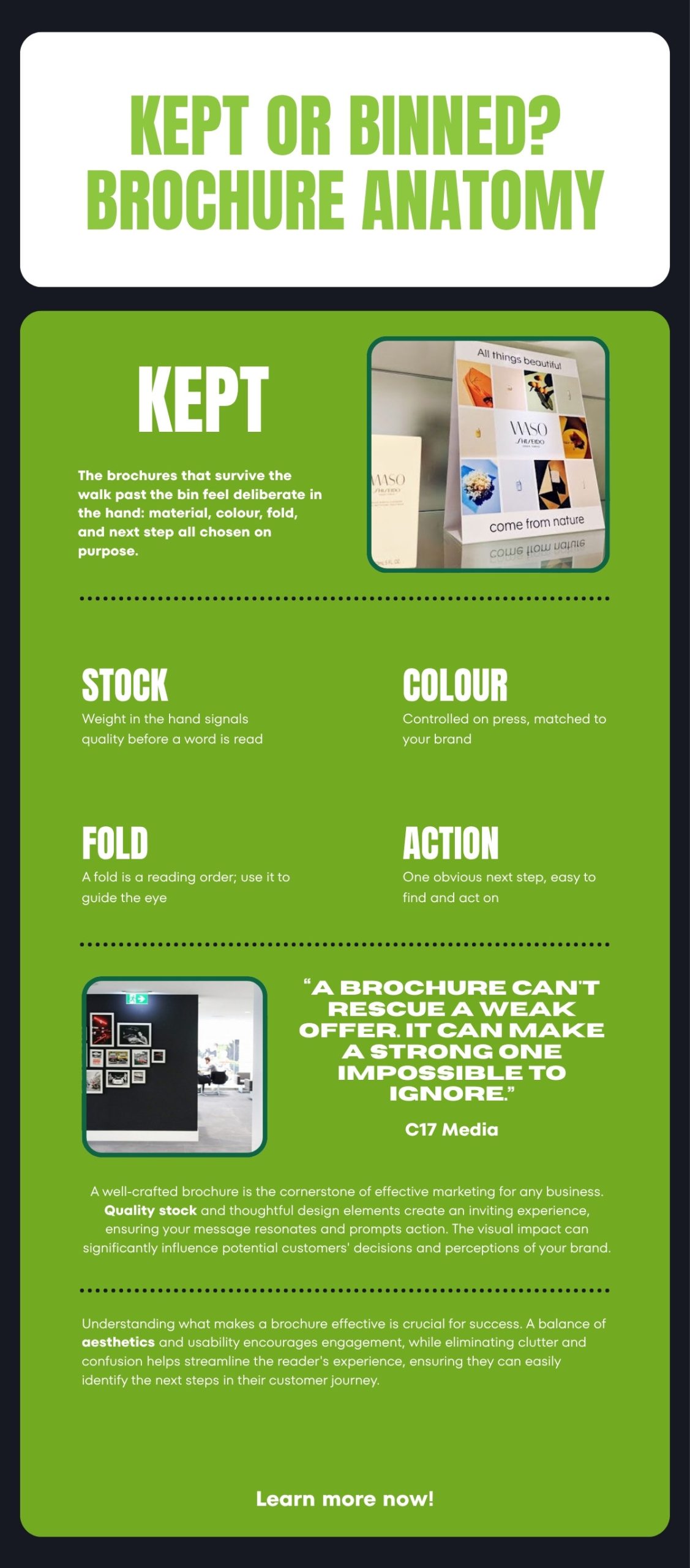
- Kept versus binned is usually decided by stock weight, finish, and fold logic before a word gets read.
- Offset suits long, identical runs. Digital suits short, versioned, updatable ones. The wrong choice buys boxes of waste.
- No print process rescues a weak offer. A good shop tells you that before the press runs.
Why Do Most Trade Show Brochures Get Binned?
Because they feel disposable, so people dispose of them. A thin sheet with edge-to-edge text and a generic stock photo communicates “mass handout” before anyone reads the headline. Attendees triage by touch. Whatever feels like paper gets treated like paper. Whatever feels like an object gets carried home.
Most binned brochures were ordered by quantity, not by purpose. Somebody asked “how many do we need?” when the better question was “what is this piece supposed to do in someone’s hand, and for whom?” Print 5,000 answers to the first question and you get 5,000 answers to nothing.
The fix starts before the file does. If you have a brochure project on the calendar, book a complimentary consultation and let us pressure-test the plan while it’s still cheap to change.
What Separates a Kept Brochure From a Binned One?
Three physical decisions, all made before production: the stock, the finish, and the fold. None of them requires a bigger budget so much as a deliberate one.
Stock weight. The hand judges before the eye does. A heavier cover stock resists flopping, holds a crease cleanly, and signals that the company behind it invests in what it makes. Lightweight text stock has legitimate uses in high-volume inserts and menus, but for a piece meant to represent your brand, flimsy reads as forgettable. People rarely bin things that feel substantial.
Finish. Gloss makes colour pop and suits product photography. Matte reads calm and premium and takes handwriting, useful when reps annotate a page mid-conversation. Soft-touch coatings invite a second pass of the thumb, which sounds trivial until you watch a booth visitor do exactly that. The right finish is matched to how the piece will be used, not picked from a checkout menu.
Fold logic. A fold is an argument structure. The front panel earns the open. The inside panels should reveal in the order a reader naturally unfolds them, and the call to action should land where the piece finishes in the hand. When a fold fights the reading order, readers stall and set the piece down. When it guides them, they finish it. Finishing is most of the battle.
You can see these decisions across the projects in our portfolio: pieces designed as objects, not as PDFs that happened to get printed.
The Brochure Is the Message Before Anyone Reads It
Print quality speaks first. In a FedEx Office survey conducted in the US, 68% of consumers said they believe a business’s signage reflects the quality of its products or services, and 52% said they were less willing to enter a store with poorly made signs (FedEx Office/Ketchum, 2012). The survey asked about signs. The instinct applies to anything printed with your name on it.
Now apply that to your brochure. A prospect at a Mississauga trade show has never visited your office or met your team. The brochure is the business, as far as their hands can tell. Muddy colour, a soft crease, a cover that curls: each one is a quiet claim about how you run everything else. Fair? Not really. But that’s how first impressions work, and no follow-up email un-rings one.
That’s why brochure colour deserves press-grade care. A dealership GM with an exact brand standard can’t hand out folders that drift warm on one batch and cool on the next. The piece either matches the brand or undermines it. There is no neutral.
Offset or Digital: Which Way Should Brochure Printing Go?
It depends on one honest question: is every copy identical, and will the content stay true long enough to use them all? Offset lithography transfers ink from a plate to a rubber blanket to the paper (PrintWiki). Making those plates takes real setup, which is why offset rewards long, identical runs with beautifully consistent colour, sheet after sheet.
Digital printing needs no plates at all. It images directly onto the substrate, which is what makes short runs and on-demand printing cost-effective (Xerox). No setup means no penalty for printing only what you’ll distribute, or for changing the file next month.
So map the process to the reality of your campaign:
- Offset earns its setup when the piece is stable: a corporate capabilities brochure, or a franchise campaign where thousands of identical copies fan out across locations.
- Digital earns its flexibility when the content moves: seasonal offers, event-specific versions, per-location pricing, a pilot you want to test before committing the brand to it.
Here’s the trap we see most. A team orders one enormous offset run to chase a lower unit cost, then the pricing changes, or the product photo gets refreshed, and the last few boxes become expensive recycling. The unit cost was low. The cost per brochure that mattered was terrible. A shorter digital run, reprinted as the message evolves, often delivers more kept brochures for less total spend, and it opens the door to versioned and personalized pieces that generic runs can’t touch.
Which should you pick? Ask a shop that runs both and has no stake in which answer you choose. C17 Media operates digital and offset presses in-house at our Richmond Hill facility, and our digital vs. offset comparison explains how each process works if you want the full picture first.
Honest Design Counsel Is Part of the Service
A press operator can’t fix a brochure that was doomed in the layout. That’s why real brochure printing includes a conversation before production: does the front panel earn the open, does the fold sequence the story properly, is there one clear next step, and will this design survive the trip from screen to paper?
That last one matters more than most buyers expect. Files that look perfect on screen routinely carry problems that print badly, and plenty of online portals print them anyway. We wrote a whole piece on why print files fail, but the short version is this: a human preflight catches on Tuesday what a bin outside the hall reveals on Sunday.
And here’s the concession an honest printer owes you: a brochure can’t rescue a weak offer. If the piece gives nobody a concrete reason to act, no stock weight or soft-touch coating will manufacture one. When a layout is carrying a message that isn’t ready, the useful thing to say is “wait,” not “how many thousand?” We’d rather lose a run than print your regret. Better to hear that from us than from the bin.
What Campaign Print Looks Like at Franchise Scale
Proof beats promises, so here’s a checkable one. Country Style trusts C17 Media with campaign print across its national franchise network, including the “Good Things Come in 3’s” campaign. Franchise campaign print is brochure discipline under pressure: every location needs identical colour, stock, and finish on the same schedule, because a customer who visits two locations notices the one that looks off. You can review the work on our Country Style brand story portfolio page.
That kind of program is where the offset-versus-digital decision stops being theoretical. Long identical components run offset for consistency. Location-specific or time-limited pieces run digital for flexibility. One shop producing both under one roof means one colour standard, one accountable team, and nobody explaining upstairs why Markham’s brochures don’t match Mississauga’s.
Sixteen years of that work, for more than 40 recognized brands, is on our walls and in our files. We’re happy to show you both.
Frequently Asked Questions About Brochure Printing
What paper stock is best for brochure printing?
It depends on the job the piece has to do. Heavier cover stocks suit brochures meant to represent the brand and be kept: sales folders, capability pieces, showroom takeaways. Lighter text stocks suit high-volume inserts where quantity matters more than heft.
Which brochure fold should I choose?
Choose the fold that matches your story’s structure. A tri-fold suits a short pitch with one clear action. Gate folds create a reveal moment for a hero product. The test is simple: unfold a blank mock-up and check that your content lands in the order a reader’s hands will discover it.
Should brochures be printed digitally or offset?
Identical content in large volume favours offset, which uses plates and rewards long runs with consistent colour (PrintWiki). Changing or versioned content favours digital, which prints directly onto the substrate with no plates and excels at short, on-demand runs (Xerox). C17 runs both processes in-house and will recommend honestly.
How many brochures should I actually order?
Order against a distribution plan, not a unit price. Count the hands the piece will realistically reach: booth traffic, sales kits, showroom racks, mailings. If content might change this year, a shorter digital run you can reprint beats a big offset run you’ll bin.
Can each location or franchise get its own version?
Yes, and franchises are exactly where versioning pays off. Shared brand elements stay identical while addresses, offers, and local details change per location. Digital production makes those variations practical, and variable data printing extends the idea down to individually personalized pieces within one run.
How do I know a print shop will get my brochure right?
Interview them. Ask whether production is in-house, how proofing works, and whether a person preflights your files before anything prints. Ask to see comparable work. Our guide to choosing a Toronto print shop lays out the full set of questions, and we’re glad to answer every one of them ourselves.
Print the Run You Won’t Regret
The bin outside the hall isn’t an argument against brochures. It’s an argument against brochures ordered by the thousand with no plan for the hand they land in. Get the stock, finish, and fold right, match the run to reality, and insist on a shop that will tell you when the smarter order is a smaller one.
C17 Media has printed for GTA businesses since 2010, with digital and offset presses under one roof in Richmond Hill and franchise campaign work running coast to coast. Book a complimentary consultation through our contact page, call 905-597-2178, or email hello@c17media.com, Monday to Friday, 9:00 to 5:30. Bring us the brochure you’re not sure anyone will keep. We’ll make sure they do, or we’ll tell you why they won’t.