Brochure Printing That Doesn’t End Up in the Bin
July 9, 2026
Distraction Markers and Bird-Friendly Film: A GTA Guide
July 9, 2026
Picture the end of your last direct mail campaign. Thousands of postcards, designed, approved, printed, mailed. Budget spent. And then: nothing. No calls, no visits, no redemptions you could point to in the review meeting. Somewhere across the GTA, your mailer landed in a stack with a flyer, a credit card offer, and a coupon book, and it went to recycling with all of them. Because it looked like all of them.
If you’re the marketing manager, franchise ops lead, or business owner who signed off on that campaign, the silence is personal. Variable data printing exists to break it. This post explains what VDP actually is, why generic blasts get binned unread, what can change from piece to piece, and how one accountable Richmond Hill shop runs the whole workflow from spreadsheet to mail-ready skids.
Key Takeaways
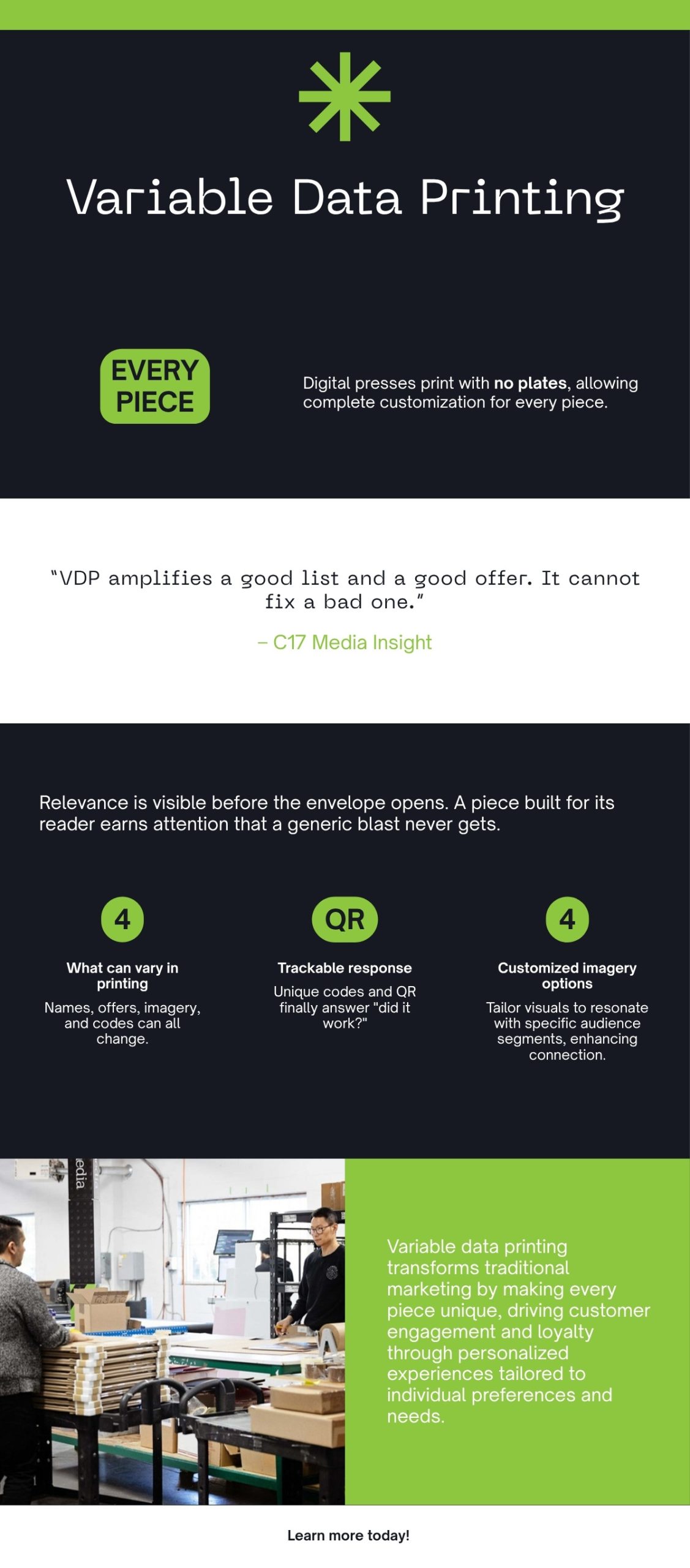
- Digital presses need no printing plates and print directly onto the substrate, so every single piece in a run can be different (Xerox).
- Names, offers, images, and unique tracking codes can all vary per recipient, which finally answers the question “did it work?”
- Digital’s share of global print value is growing, from 17.2% in 2021 to a forecast 21.6% in 2026 (Smithers).
- VDP amplifies a good list and a good offer. It cannot rescue a bad one.
What Is Variable Data Printing?
Variable data printing is digital printing where the content changes from piece to piece within a single run, driven by a data file. As Xerox explains, digital presses require no plates and print directly onto the substrate, which is exactly what makes this possible: with no fixed plate, there is no fixed image (Xerox).
Compare that with traditional offset. An offset press transfers one image from a plate to a blanket to paper, so every sheet in the run is identical by design. That’s a strength when you want ten thousand perfect copies of the same brochure. It’s a limitation when you want ten thousand different ones. A digital press treats piece number 4,801 as its own job: new name, new offer, new photo, new code, at production speed.
The result is a mailer addressed to a person instead of a postal route. Not “Dear Homeowner” but a card that greets Priya by name, shows the Markham location she actually drives past, and carries an offer built for customers like her. If you’re still weighing the two processes generally, our digital vs. offset printing comparison covers where each one wins.
Planning a campaign right now? Book a complimentary consultation and bring your list. We’ll tell you honestly what it can support before you spend a dollar on postage.
Why Do Generic Mail Blasts Fail?
They fail because irrelevance is visible before the envelope is even open. People sort mail standing over a recycling bin, and the decision takes about as long as it takes to flip the piece over. A generic mailer announces itself instantly: stock photography, a one-size-fits-nobody offer, a greeting that could apply to anyone with a mailbox. The reader correctly concludes it wasn’t really for them, because it wasn’t.
Here’s the uncomfortable math of a generic blast. You paid printing and postage on every piece, including the majority that were irrelevant to whoever received them. That’s cousin to the false economy we unpacked in the true cost of cheap printing: money that looked well spent until the results came in.
Relevance flips the sorting decision. A piece that names your street’s neighbourhood, your nearest store, or your last purchase earns a second look, and the second look is where direct mail either lives or dies. VDP doesn’t make mail cheaper. It makes fewer pieces wasted.
The Four Variables That Do the Work
More than most buyers assume. The address block is just the beginning; on a variable-data-capable digital press, nearly any element of the design can respond to the data. In practice, four categories do most of the work:
- The recipient’s name, inside the design. Not just on the envelope, but set into the headline, the offer, even rendered into an image. “Sarah, your patio season starts here” outperforms anonymity for a simple reason: we notice our own names.
- Location-specific offers. A franchise network can mail one campaign where the Vaughan piece shows the Vaughan store, its hours, and its map, while the Mississauga piece shows Mississauga’s. One file, one run, every recipient pointed at the right door.
- Imagery by segment. Existing customers see the product they own. Prospects see the entry offer. A dealership can show each household the model closest to what they last serviced or browsed.
- Unique codes and QR codes. Every piece can carry its own redemption code, QR destination, or personalized URL. This is the quiet superpower: when responses come in, you know exactly which piece, which segment, and which offer produced them. For the first time, “did the mail work?” has an answer you can defend upstairs.
This is the logic behind successful multi-location campaign print. When Country Style needed campaign materials across its national franchise network, the challenge was one brand speaking with local relevance everywhere at once; see that program in our portfolio. VDP brings the same principle to the mailbox.
The Part the Sales Pitch Leaves Out
Honesty time. Variable data printing is an amplifier, not a defibrillator. It makes a good list and a good offer work harder, and it makes a bad one fail with better typography. If your data is five years stale, personalization means confidently greeting people who moved away in 2021. If your offer wouldn’t tempt anyone at full volume, it won’t tempt them with their name attached.
So before any campaign touches a press, interrogate the inputs. Is the list current, deduplicated, and legitimately sourced? Does each segment actually differ in a way the design can use? Is the offer something a rational person would act on? A shop that takes your money without asking those questions is printing, not partnering. We’d rather lose a week tightening your data than mail a beautiful campaign to a graveyard of old addresses.
Get the inputs right, though, and the effect compounds. Good list, sharp offer, piece-level relevance, trackable response. Each element strengthens the others, and the campaign stops being a hopeful blast and starts being a measurable channel.
What Does the Workflow Look Like With One Accountable Shop?
With one shop, it looks like a hallway. Your data, your design, the press, and the finishing department all sit under the same roof, and one team answers for the whole chain. Split the job between a data house, an online printer, and a mailing service, and every handoff becomes a place for errors to hide and fingers to point. We made the broader case for single-point accountability in our guide to choosing a Toronto print shop; with variable data, the stakes are higher because a data error doesn’t ruin one piece, it ruins thousands, each one differently.
Two stages deserve special attention. Data handling means your list is treated as confidential input, checked for duplicates and missing fields before a single record is merged. Variable proofing means we don’t just approve one pretty sample; we pull real records, including the awkward ones with long names, and confirm the layout holds for all of them. Then production runs, finishing makes everything mail-ready, and your codes stand by to report back. One phone number the whole way through. That’s the point.
How Do You Get Personalization at Real Volume?
You combine the presses. This is where running digital and offset production under one roof becomes a strategy: print the static shell of the piece on offset, where consistency and colour shine at volume, then run those shells through the digital press to imprint the variable layer, the names, offers, and codes that change per recipient.
The shell-plus-imprint approach gives you both halves of what a big campaign wants. Offset delivers the rich, repeatable brand canvas across the entire run. Digital delivers the per-piece variance that earns the second look. Buyers who order the shell in quantity can also draw from it across waves of a campaign, imprinting each wave with fresh offers as results come in. The same thinking applies to any collateral that has to earn its keep, a case we made in brochure printing that works.
The market is already moving this way. Smithers forecasts global print at $834.3 billion in 2026, with digital’s share of that value climbing from 17.2% in 2021 to 21.6% in 2026 (Smithers). C17 Media runs variable-data-capable digital presses alongside offset in our 15,000 square foot Richmond Hill facility, so the shell, the imprint, and the finishing never leave the building, and neither does accountability. You can see the range of that work in our portfolio.
Frequently Asked Questions About Variable Data Printing
What is variable data printing in simple terms?
It’s digital printing where a data file changes the content of each piece in the run. Because digital presses use no plates and print directly onto the substrate, every postcard, letter, or card can carry a different name, offer, image, or code (Xerox).
Is variable data printing only for direct mail?
No. Direct mail is the flagship use, but the same capability produces event badges, numbered tickets, membership cards, personalized coupons, localized franchise materials, and serialized packaging inserts. Anywhere identical pieces would be a compromise, VDP is the alternative. Our print services page covers the broader production range.
What data do I need to provide?
A clean, current spreadsheet or database export: names, addresses, and whatever fields drive the personalization, such as location, segment, or purchase history. We review it for duplicates, formatting problems, and gaps before merging. The better the data, the better the campaign; no press can out-print a stale list.
Does personalization just mean adding a first name?
That’s the shallow end. Real VDP varies offers by location, imagery by customer segment, and codes by individual recipient. A first name earns a glance. A piece showing the right store, the right product, and an offer worth acting on earns a response.
Can variable data printing work with offset?
Yes, through the shell approach: offset prints the static design at volume, then a digital press imprints the variable elements onto those shells. You get offset’s colour and economy plus digital’s per-piece variance. See our digital vs. offset explainer for how the two processes divide the work.
How do I finally prove direct mail worked?
Give every piece its own redemption code, QR code, or personalized URL. When responses arrive, they identify exactly which recipient, segment, and offer produced them. That turns the post-campaign meeting from “we think it helped” into a report with receipts.
Where does C17 Media produce variable data campaigns?
Everything runs in-house at 30 West Beaver Creek Rd, Unit 12, Richmond Hill, serving Toronto, Markham, Vaughan, Mississauga, and clients Canada-wide. Data handling, printing, and mail-ready finishing stay under one roof with one accountable team.
Mail Worth Opening, Results Worth Reporting
The difference between mail that gets read and mail that gets recycled is rarely the paper. It’s relevance: the recipient’s own name in the design, their nearest location, an offer aimed at them, and a code that tells you they answered. Variable data printing delivers all four, provided the list and the offer deserve it.
C17 Media has printed for GTA businesses since 2010, with variable-data-capable digital presses and offset production side by side in one Richmond Hill facility. Book a complimentary consultation through our contact page, call 905-597-2178, or email hello@c17media.com, Monday to Friday, 9:00 to 5:30. Tell us who your mailer needs to reach, and we’ll show you what it looks like when every piece arrives already relevant.