
Dye Sublimation Printing Explained: How It Works
June 1, 2026
Custom Wall Murals for Business Spaces: A Complete Guide
June 15, 2026
Drive through almost any corner of the GTA and you’ll pass a construction site within minutes. Every one of those sites is wrapped in hoarding, the temporary barrier that separates the work zone from the public. Most of it sits blank. That’s a missed opportunity, because out-of-home advertising is thriving: US OOH revenue reached a record $9.46 billion in 2025, up 3.6% year over year (OAAA, 2026). Construction hoarding graphics turn a barrier you’re already required to build into street-level media you control. This guide covers what hoarding graphics are, why developers brand them, what municipalities expect, and how to design panels that actually get read. Our large format printing team produces them regularly for sites across the region.
Key Takeaways
- Construction hoarding graphics convert mandatory site barriers into branded, street-level advertising for developers and contractors.
- US out-of-home ad revenue hit a record $9.46 billion in 2025 (OAAA, 2026), and hoarding is one of the cheapest ways into that channel.
- GTA municipalities regulate hoarding through permits and bylaws that vary by city, so confirm local requirements before printing.
- Outdoor durability matters: UV-stable inks, weather-rated vinyl, and graffiti-resistant finishes keep panels presentable for the life of the project.
What Are Construction Hoarding Graphics?
Construction hoarding graphics are large-format printed panels applied to the temporary fencing or plywood barriers around a construction site. They matter because the public judges what it sees: in a US survey, 76% of consumers entered a store they had never visited before based on its signage (FedEx Office, 2012). A construction site is no different.
The hoarding itself is usually plywood, wood-frame walls, or solid fence panels installed to protect pedestrians and screen the work zone. The graphics layer goes on top. That layer can be printed vinyl applied directly to the boards, rigid printed panels fastened over the structure, or banner and mesh material where the barrier is chain-link rather than solid.
In practice, hoarding graphics fall under the wide-format printing umbrella. If you want the full picture of how these large graphics get produced, our wide format printing guide breaks down the technology and the terminology.
Why Do Developers and Contractors Brand Their Hoarding?
Branded hoarding works because people genuinely notice outdoor media. A US study found 90% of travellers noticed out-of-home advertising in the past month, and 66% of smartphone users took action after seeing an OOH ad (Nielsen/OAAA, 2019). A condo hoarding on a busy Toronto artery earns that attention every single day, for months or years.
Four motivations come up again and again with GTA developers and general contractors:
Pre-sales and leasing marketing. For residential and commercial projects, the hoarding is often the first sales tool on site. Renderings, presentation centre directions, and a sales URL reach people who already spend time in the neighbourhood. The same Nielsen study found more than 40% of viewers searched the advertised brand afterwards, exactly the behaviour a pre-construction campaign wants.
Wayfinding. Active sites disrupt sidewalks, entrances, and transit stops. Clear directional graphics keep pedestrians moving safely and point customers to businesses that stay open through construction.
Community relations. Construction is noisy and slow. Hoarding that explains what’s coming, celebrates the neighbourhood, or features local artwork softens the disruption, and many GTA projects dedicate hoarding space to community messaging for exactly this reason.
Hiding the mess. A muddy excavation behind bare plywood says “disruption.” A clean, branded wall says “progress.” Perception carries over to the builder: 68% of consumers in the FedEx survey said a business’s signage reflects the quality of its products or services (FedEx Office, 2012).
Planning a project in the GTA? Book a complimentary project consultation and we’ll walk your site plan with you.
What Do GTA Municipalities Require for Hoarding?
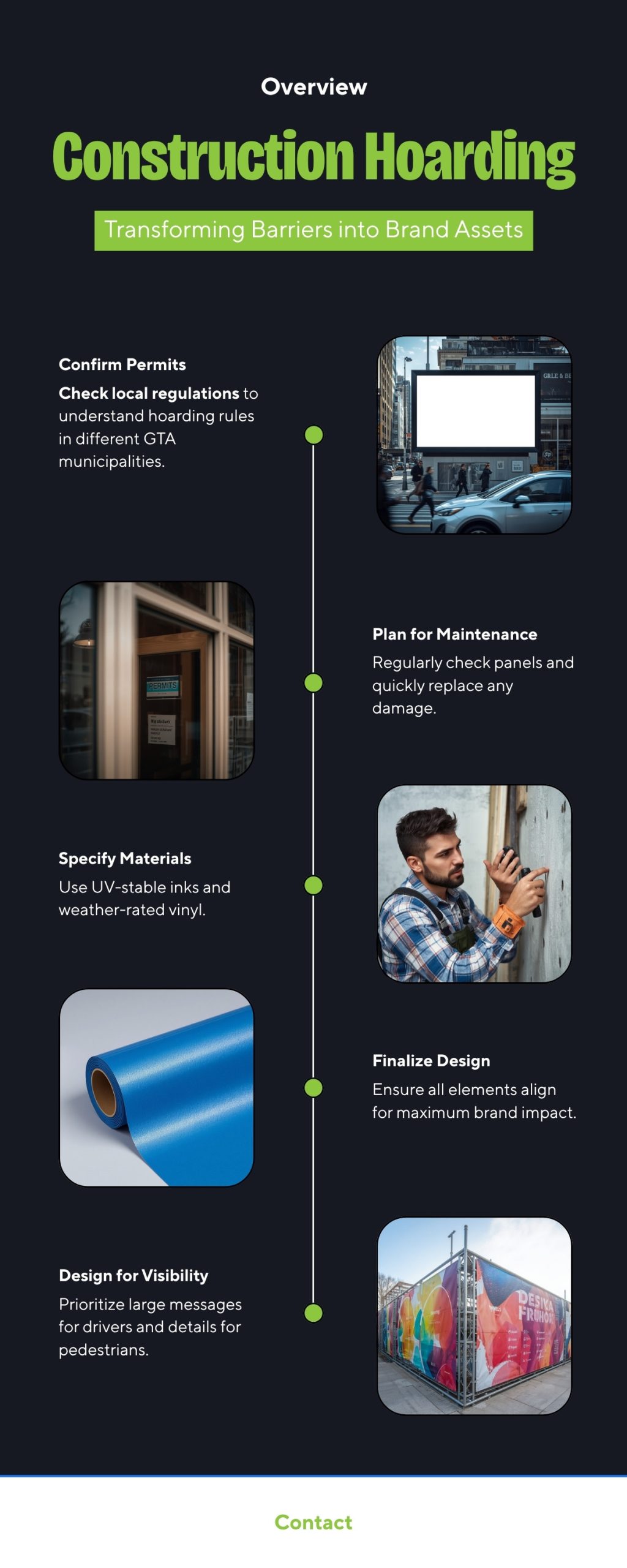
Hoarding is regulated infrastructure, not optional decoration. Municipalities across the GTA require permits for construction hoarding, particularly where it occupies or borders a public sidewalk, boulevard, or roadway, and the rules differ from one city to the next. Toronto, Richmond Hill, Vaughan, Markham, and Mississauga each administer their own bylaws and permit processes.
We deliberately won’t quote specific bylaw numbers, fees, or dimensional rules here. Those details change, and the correct source is always the municipality where your site sits. In general terms:
- Permits usually come first. Hoarding that encroaches on public property typically needs municipal approval, and graphics may be reviewed as part of that process.
- Safety requirements shape the design. Sightlines at corners, pedestrian protection, and lighting rules all influence where graphics can go.
- Some municipalities encourage or require decorated hoarding. In parts of the GTA, public art and graphic treatment programs exist specifically for construction sites.
- Advertising content may be treated differently than site identification. Third-party ads on hoarding can trigger separate sign permissions in some jurisdictions.
Your general contractor or permit consultant normally manages these approvals. We’ve found that looping the printer in before the permit drawings are final saves everyone a reprint.
Materials and Durability for Toronto Job Sites
Hoarding graphics live outside through everything southern Ontario throws at them: summer UV, freeze-thaw cycles, wind, road salt spray, and the occasional marker or spray can. Material choice determines whether panels still look sharp when the sales office opens. Poorly weathered signage actively hurts you; 52% of consumers say they’re less willing to enter a store with poorly made signs (FedEx Office, 2012).
The main considerations, kept qualitative because every site differs:
UV and colour stability. Direct sun fades cheap prints. UV-stable inks and media hold brand colours through long exposure, which matters when your hoarding carries a developer’s carefully guarded palette.
Weather resistance. Panels must handle rain, snow load against the structure, and temperature swings. Adhesive vinyl needs to bond in Canadian conditions and stay bonded; our vinyl printing work for exterior applications is specified with exactly this in mind.
Graffiti considerations. High-traffic urban hoarding gets tagged. Anti-graffiti laminates let crews wipe most tags off without destroying the print underneath. A smart fallback: design in modular panels so a damaged section can be reprinted and swapped rather than redoing the whole run.
Substrate pairing. Vinyl over plywood, rigid printed panels, and mesh banners on fencing each behave differently. Mesh lets wind pass through on open fence lines. Rigid panels give the cleanest finish on solid walls. The right answer depends on the barrier your contractor is building.
How Do You Design Hoarding for Drive-By and Walk-By Readability?
Design for two audiences at once: drivers who get seconds and pedestrians who get minutes. The hierarchy should let a driver absorb the project name and one message at a glance, while a pedestrian walking the full length of the hoarding gets the deeper story panel by panel.
A few principles we apply on every hoarding project:
- One idea per panel. Pedestrians read hoarding sequentially, like pages. Give each panel a single message and let the sequence build the story.
- Contrast beats decoration. Bold type on a clean background outperforms busy renderings stretched across the entire run. Save the detailed imagery for the walk-by zone.
- Put contact information at eye level. QR codes and URLs belong where a standing person can scan them, not three metres up.
- Respect the seams. Hoarding is built in sections. Design to the panel grid so critical text never lands on a joint.
- Keep it current. “Coming 2025” on a wall in 2026 undermines the whole investment. Plan for milestone updates.
The same visual thinking applies indoors once the building opens; our guide to custom wall murals for business covers how large graphics carry a brand inside the finished space.
Installation and Maintenance Over the Life of the Project
Hoarding graphics have to hold up for the life of the project. Installation quality and a maintenance plan decide how the wall looks in month eighteen. There’s supporting evidence that the effort pays off: businesses that improved their signage reported sales increases of roughly 10% in a US economic study (University of Cincinnati Economics Center, 2012).
A typical project flow looks like this:
- Site survey and measurement. Confirm as-built hoarding dimensions, the panel grid, obstructions, and access points. Drawings rarely match the final structure exactly.
- Substrate preparation. Plywood needs priming or sealing for vinyl adhesion; fencing needs proper attachment points for mesh or rigid panels.
- Sequenced installation. Crews work panel by panel around gates, required site signage, and active construction access.
- Inspection and documentation. Photograph the finished run as proof of condition and a reference for replacements.
- Ongoing maintenance. Budget for graffiti cleaning, damage swaps, and content updates at milestones like sales launches.
The maintenance line item is the one developers most often skip, and the one that matters most. Our production services team keeps replacement files on hand so a damaged panel can be reprinted without restarting the project.
Frequently Asked Questions About Construction Hoarding Graphics
Do I need a permit for construction hoarding graphics in the GTA?
Hoarding itself typically requires municipal permits, especially when it borders or occupies public property, and graphics may be reviewed as part of that approval. Requirements vary between Toronto, York Region municipalities, and Peel. Confirm with your local municipality; your general contractor or permit consultant usually manages the process.
What materials are used for hoarding graphics?
Common options include adhesive vinyl applied to plywood hoarding, rigid printed panels fastened over the structure, and mesh banners for chain-link fencing. All should use UV-stable inks and weather-rated media. Anti-graffiti laminates are a smart addition on high-traffic urban sites where tagging is likely.
Is branded hoarding actually effective advertising?
The evidence for outdoor media is strong. In US research, 90% of travellers noticed out-of-home advertising in the past month and 66% of smartphone users took action after seeing an OOH ad (Nielsen/OAAA, 2019). Hoarding delivers that exposure on real estate you already control.
How long do hoarding graphics need to last?
They need to last the life of the construction phase, which can run from months to several years on large GTA projects. Rather than quoting fixed lifespans, we specify materials to the project timeline, the site’s sun and weather exposure, and the client’s tolerance for mid-project refreshes.
Can hoarding graphics be updated during construction?
Yes, and they should be. Modular panel design lets you swap individual sections for milestone updates, sales campaign changes, or graffiti and damage replacement without reprinting the entire run. Keeping print files on record with your printer makes each swap fast and colour-consistent.
What should a developer put on hoarding for a pre-construction project?
Lead with the project name and one drive-by message in large type. Add renderings, key features, and neighbourhood messaging along the pedestrian route, then place the sales centre address, URL, and a QR code at eye level. Make the next step obvious for the person standing in front of the wall.
Turn Your Site Barrier into Your Best Billboard
Construction hoarding is mandatory. Blank hoarding is a choice, and with outdoor media attention as strong as it is, an expensive one. Sort the permits with your municipality, specify materials for Toronto weather, design for drivers and walkers alike, and budget for maintenance.
C17 Media has produced large-format graphics for GTA businesses and national brands since 2010, from hoarding and outdoor signage to complete site branding programs. See recent projects in our work, then book a complimentary project consultation. Call 905-597-2178 or email hello@c17media.com and we’ll help you plan panels that earn their place on the street.