
Construction Hoarding Graphics: Branding GTA Building Sites
June 8, 2026
Step and Repeat Banners: The Complete 2026 Guide
June 22, 2026
Walk into any memorable office, showroom, or shop in the GTA and odds are a wall got your attention before a person did. That reaction is measurable. In a US survey commissioned by FedEx Office, 68% of consumers said a business’s signage reflects the quality of its products or services (FedEx Office/Ketchum survey, 2012). Your walls are the largest branded surface you own, and most businesses leave them beige.
This guide explains what custom wall murals actually are, how printed vinyl compares with hand-painted murals, why surface prep decides everything, and what the design-to-install process looks like when it’s done properly. We’ve been printing and installing wall graphics across the Greater Toronto Area since 2010, so we’ll show you a real install along the way.
Key Takeaways
- Custom wall murals come in three main forms: adhesive vinyl, fabric wallcoverings, and direct-print graphics. Each suits different surfaces and lease situations.
- Printed murals win on speed, photographic detail, removability, and cost predictability. Painted murals win on texture and one-of-a-kind artistry.
- In a US FedEx Office survey, 76% of consumers entered a store they had never visited before because its signs caught their eye.
- Surface preparation makes or breaks an install. Fresh paint, dust, and wall texture all affect adhesion.
What Counts as a Custom Wall Mural?
A custom wall mural is any large-scale printed or painted graphic applied across a wall as a single continuous visual. In commercial printing, that almost always means one of three things: adhesive vinyl panels, fabric wallcoverings, or graphics printed directly onto a rigid substrate that gets mounted to the wall.
Printed vinyl murals are the workhorse. Artwork is printed onto wide rolls of adhesive vinyl, laminated for scuff resistance, then applied to the wall in overlapping or butt-joined panels. Done well, the seams disappear and the wall reads as one image.
Fabric wallcoverings behave more like premium wallpaper. Printed fabric materials offer a softer, matte finish that designers often prefer in hospitality and executive spaces, and many are paste-free and repositionable during install.
Direct-print and mounted graphics put the image on rigid panels first. This suits feature walls, dimensional layouts, and surfaces where adhesive vinyl won’t cooperate.
There’s also a close cousin worth knowing: architectural films that mimic wood, stone, and metal rather than displaying artwork. We cover those in our guide to 3M DI-NOC architectural film. And if you want the full picture of how murals fit into the broader category, our wide format printing guide tours every application.
Not sure which format fits your wall? Book a complimentary project consultation and we’ll assess the space with you.
Why Do Businesses Invest in Wall Murals?
Because walls work harder than almost any other branded surface, and the research on environmental graphics backs that up. In the FedEx Office study, 76% of American consumers said they had entered a store they’d never visited before based on its signs, and 52% said they were less willing to enter a store with poorly made signage (FedEx Office/Ketchum survey, 2012).
The effect isn’t just about foot traffic. A University of Cincinnati Economics Center study found that businesses that improved their signage reported increases in sales, profits, and transactions of roughly 10% (UC Economics Center, 2012). Both are US studies, but the behaviour they describe travels well.
So where do murals earn their keep?
Offices. Culture walls, mission statements, and oversized brand graphics turn corridors and lobbies into a statement about who you are. Candidates notice during interviews. Clients notice during tours.
Retail. Murals set the mood the moment someone crosses the threshold, guide shoppers toward key departments, and give people a reason to photograph your space. Free reach, essentially.
Showrooms. We’ve produced graphics for automotive brands including Audi, BMW, and Porsche, where a full-wall image frames the product without competing with it.
Hospitality. Restaurants, cafés, hotels, and gyms use murals to build atmosphere that furniture alone can’t deliver.
Heritage and culture walls. Timelines, founder stories, and milestone graphics that make a company’s history visible to the people who live it daily. More on this below, because we’ve built one.
Vinyl Murals vs Painted Murals: Which Should You Choose?
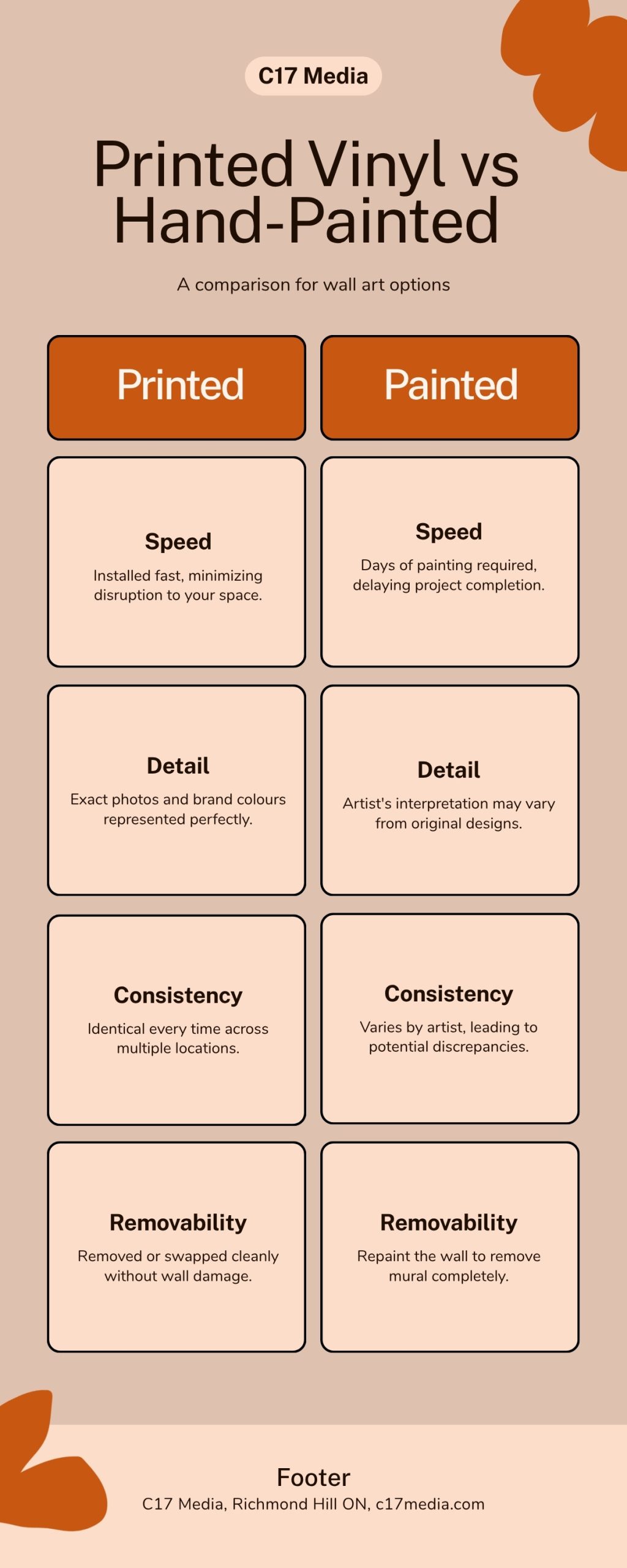
Printed vinyl suits most business timelines and brand-accuracy needs, while hand-painted murals suit spaces chasing a one-of-a-kind artisan feel. Neither is universally better. The honest comparison comes down to five trade-offs.
Speed. A printed mural is produced in-house and installed in a fraction of the on-site time a painted mural requires. Your space isn’t a studio for days on end, which matters when the wall is behind a cash desk or in a working office.
Photographic detail. Print reproduces photography, fine gradients, and exact brand colours with total fidelity. A painter interprets; a printer replicates. If your mural includes product photos, team portraits, or archival images, print is the only realistic route.
Consistency. Rolling the same mural out across three locations? Printed graphics come out identical every time. Painted work varies by artist and by day.
Removability. Vinyl murals can be removed or swapped when campaigns change or leases end. A painted mural means repainting the entire wall, then painting again.
Cost predictability. A printed mural is quoted up front from the artwork and the wall dimensions. Painted murals depend on artist time, and scope has a way of growing once brushes hit drywall.
At a glance:
| Printed vinyl mural | Hand-painted mural | |
|---|---|---|
| Speed on site | Installed in a fraction of the time | Days of on-site painting |
| Photographic detail | Total fidelity to photos and brand colours | Artist’s interpretation |
| Multi-location consistency | Identical every time | Varies by artist and day |
| Removability | Removed or swapped cleanly | Repaint the wall |
| Cost predictability | Quoted up front from artwork and dimensions | Scope grows with artist time |
Where does paint still win? Texture, imperfect charm, and the story of a local artist’s hand. Some hospitality concepts want exactly that. For most offices, showrooms, and retail environments, though, large format printing delivers the brand accuracy and schedule certainty the project actually needs.
The Design-to-Install Process, Step by Step
A proper mural project follows five stages: consultation and measurement, design and proofing, material selection, production, and professional installation. Skipping any of them is how walls end up with bubbles, mismatched seams, or a logo stretched into the wrong proportions.
Consultation and measurement. Someone stands in front of the actual wall with a tape measure. Outlets, thermostats, door frames, and baseboards all get mapped so the design works around them instead of colliding with them.
Design and proofing. Artwork gets built or scaled to the wall’s exact dimensions. Resolution matters enormously here: an image that looks sharp on a laptop can fall apart at three metres wide. You approve a scaled proof before anything prints.
Material selection. Smooth drywall, painted concrete, brick, and glass each call for different media and adhesives. This is where an experienced architectural graphics team earns its fee.
Production. Printing, laminating, trimming, and panel-matching, all checked against the proof.
Installation. Trained installers align panels, manage seams, and work the material around obstacles. This is the step that separates a mural from expensive wallpaper regret.
Surface Prep: The Step That Decides Everything
Adhesive vinyl bonds to whatever is on the wall, not to the wall itself. If the surface is dusty, greasy, flaking, or freshly painted, the mural is bonding to a failure waiting to happen. In our experience, most peeling murals trace back to prep shortcuts, not to the material.
A few things a good installer checks before committing:
- Paint condition and cure. Freshly painted walls need to fully cure before vinyl goes up, and certain low-adhesion or washable paint formulations resist adhesives outright. An adhesion test on an inconspicuous patch answers the question before install day.
- Texture. Orange-peel drywall, block, and brick need conformable media and sometimes heat during application. Standard vinyl on heavy texture lifts at the high points.
- Cleanliness. Construction dust, kitchen grease, and cleaning-product residue all sabotage bonds. Walls get cleaned and dried properly first.
- Repairs. Nail holes, gouges, and patches telegraph through thin media. Fix the wall, then wrap it.
None of this is glamorous. All of it determines whether your mural still looks installed-yesterday when the lease renews.
A Real Install: The Employee-Area Heritage Wall
Here’s what this looks like when it comes together. We designed, printed, and installed a floor-to-ceiling heritage wall for a client’s employee area, turning a plain corridor surface into a graphic tribute to the company’s history and people.
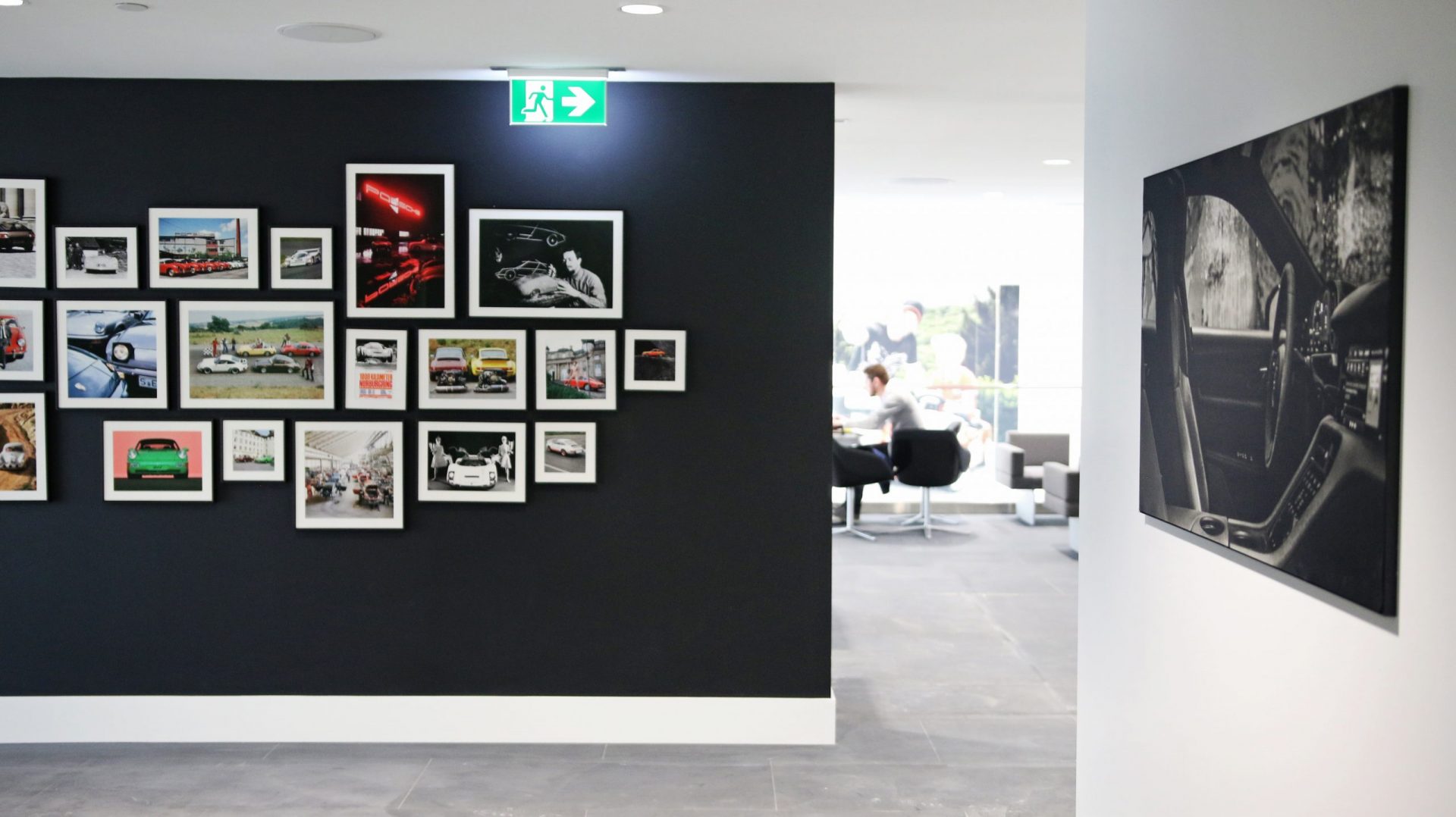
Why put a mural where customers never go? Because the audience that sees it every single day is the one that builds the product. Heritage walls give long-serving staff a visible place in the story and give new hires an instant sense of what they’ve joined. The wall was measured on site, the artwork proofed at scale, and the panels installed around the room’s fixtures so the finished piece reads as one continuous graphic.
It’s one project from a portfolio that spans more than 40 recognized brands, including Shopify and Hudson’s Bay. You can browse more installs on our work page.
Frequently Asked Questions About Custom Wall Murals
How long does a vinyl wall mural last?
It depends on the material grade, the laminate, sun exposure, and the condition of the wall underneath. Manufacturers rate their films differently, so we spec the media to your intended duration: a short-term campaign wall and a permanent lobby feature call for different products.
Can a wall mural be removed without damaging the paint?
Usually, yes, when the right adhesive is matched to the surface. Removable and repositionable films are designed to come off cleanly from sound, well-cured paint. Walls with poor-quality paint or unpatched repairs carry more risk, which is exactly what a pre-install adhesion test catches.
Can you print a mural from our own photos?
Absolutely, provided the files carry enough resolution for the finished size. A phone snapshot rarely survives enlargement to a full wall, while professional photography and high-resolution archival scans typically do. Send us the wall dimensions and the file, and we’ll tell you honestly whether it will hold up.
What surfaces can murals be installed on?
Smooth drywall is the easiest, but murals also go onto glass, painted concrete, block, and brick with the right conformable media. Heavily textured or damaged surfaces sometimes do better with mounted rigid panels, or with an architectural film approach instead of adhesive vinyl.
Do wall murals make sense in a leased space?
They’re one of the most lease-friendly branding options available. Removable vinyl lets you brand a rented office or retail unit boldly, then return the walls to their original state at the end of the term. Confirm any restrictions in your lease, and choose media rated for clean removal.
How do we get started with C17 Media?
Start with rough wall dimensions, a few photos of the space, and any brand assets or concepts you have. From there we handle measurement, design, proofing, production, and installation across the GTA. Request a complimentary project consultation and we’ll take it from the first site visit.
Ready to Put Your Walls to Work?
Blank walls are paid-for square footage doing nothing. A custom wall mural turns that space into the first thing clients photograph, the backdrop of every office tour, and a daily reminder to your team of what the brand stands for. The research says environments shape buying decisions; your walls are the biggest part of that environment.
C17 Media has designed, printed, and installed wall graphics for GTA businesses for 16 years, from single feature walls to multi-location retail rollouts. Book a complimentary project consultation, call us at 905-597-2178, or email hello@c17media.com and tell us about the wall you’ve been staring at.