
Custom Wall Murals for Business Spaces: A Complete Guide
June 15, 2026
Wide Format Printing: The Complete Guide for Businesses
June 29, 2026
Walk the media wall at any Toronto gala and you’ll see the same thing: a backdrop covered in alternating logos, photographed hundreds of times in a single night. That backdrop is a step and repeat banner, and it might be the hardest-working piece of print at the entire event. It trades on the same visibility economy the out-of-home industry tracks, a channel that reached a record $9.46 billion in US revenue in 2025 after 19 straight quarters of growth (OAAA, 2026). This guide covers what step and repeat banners are, how to size one, how to space the logos, and why fabric usually beats vinyl once the flashes start firing. We’ve printed for events across the GTA since 2010, so we’ll share what actually works.
Key Takeaways
- A step and repeat banner is a logo-patterned photo backdrop named after a prepress printing technique.
- Most photo walls stand 8 feet tall; width depends on how many people pose at once.
- Matte fabric diffuses camera flash; glossy vinyl can bounce glare straight into the lens.
- 66% of smartphone users took action after seeing an out-of-home ad (Nielsen/OAAA, 2019).
What Is a Step and Repeat Banner?
A step and repeat banner is a large printed backdrop covered in a repeating pattern of logos, usually two or more brands alternating in a staggered grid. Guests stand in front of it for photos, and every shot captures at least one clean, readable logo beside each face. That’s the entire job.
The name comes from the print industry itself. In traditional prepress work, “step and repeat” described the technique of duplicating one image across a plate at fixed intervals: step the image over, repeat it, step again. Event backdrops borrowed both the technique and the name.
You’ll hear other names for the same product: media wall, press wall, red carpet backdrop, logo wall. They all describe the same piece of large format printing, sized for cameras rather than casual viewing.
Why do sponsors love them? Because every photo taken in front of one becomes a small piece of advertising. A FedEx Office survey found 76% of consumers had entered a store they’d never visited before based on its signage (FedEx Office, 2012). Print that people deliberately photograph works even harder, because the impression travels with the image.
Planning an event? Book a complimentary project consultation and we’ll help you spec the right backdrop before you commit to a size.
What Size Should a Step and Repeat Banner Be?
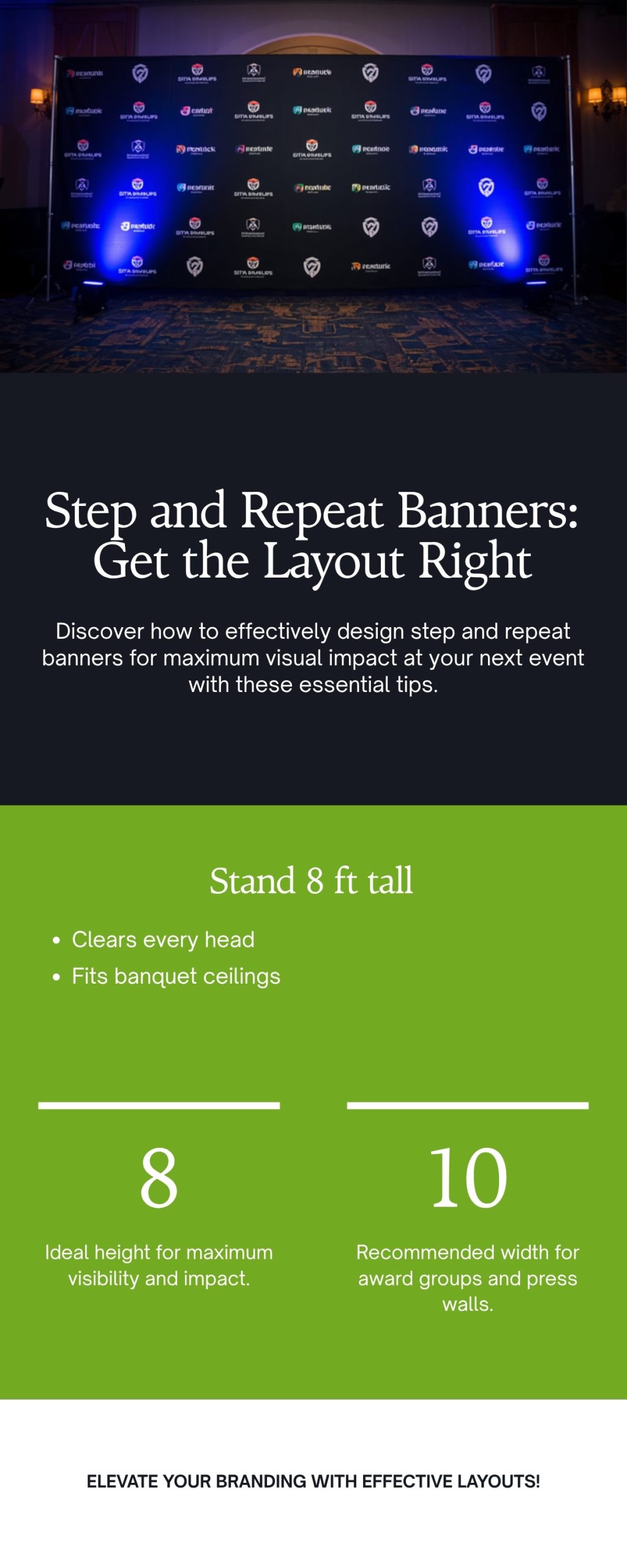
Most step and repeat banners stand 8 feet tall. That height clears every head in the frame, fills the background of a vertical shot, and still fits under standard banquet hall ceilings. Width is the real decision, and it depends entirely on who’s being photographed.
An 8 by 8 foot wall handles singles, couples, and small trios comfortably. Move up to 8 by 10 or 8 by 12 feet when award winners and sponsor teams line up in groups, so the people on the ends aren’t floating off the edge of the print. Premiere-style press walls often run wider still, giving photographers room to work several angles at once.
Measure the venue before you commit. Check ceiling height at the actual banner position, not the room average, and confirm how the backdrop gets in: freight elevator dimensions have humbled many oversized frames.
Short on floor space? Registration desks and hallways can carry sponsor branding with mounted event posters or a slim banner stand instead of a full wall.
How Do You Space Logos on a Step and Repeat Banner?
Space logos in a staggered grid, offset each row by half a step, and keep every mark roughly the same visual size. Done well, at least one complete logo lands beside each guest’s face in every photo. Done poorly, logos get cropped, covered, or lost, and the sponsor value disappears with them.
Start with the alternation pattern. Two brands? Alternate them across each row, then shift every second row by half a step so the columns don’t stack into vertical stripes. Three or more brands follow the same rule: keep the sequence consistent so no sponsor can claim the layout buried them.
Size for equal visual weight, not equal dimensions. A wide wordmark and a compact round badge set to identical widths will never look balanced. Scale each mark by eye until they carry the same presence, then lock the spacing.
Prioritize the photo zone. The band from roughly waist height to just above head height does nearly all the work, because that’s where logos land beside faces. Corners and lower edges matter far less. Keep full, uncropped logos inside that band and let partial repeats fall at the outer edges.
Quality shows up on camera before anything else does. In the same FedEx Office survey, 68% of consumers said signage reflects the quality of a business, and 52% were less willing to enter a store with poorly made signs (FedEx Office, 2012). A pixelated logo enlarged to a metre wide sends exactly the wrong message at a black-tie event.
Want to see staggered layouts at full scale? Browse our recent work for examples across events and retail.
Fabric or Vinyl: Which Looks Better on Camera?
Matte fabric wins on camera, and it isn’t close. Printed polyester fabric has a soft matte surface that diffuses flash instead of bouncing it back at the lens, so faces and logos stay evenly lit. Glossy vinyl can fire a hotspot straight into the photo, washing out the very logos your sponsors paid to show.
Wrinkles behave differently too. Fabric ships folded, then steams smooth on site. Vinyl remembers every crease, and event lighting will find each one.
Handling is the quiet advantage. A printed fabric backdrop folds into a carry bag that one person can manage on transit, and it survives repeated events without cracking or curling.
Mounting options run from pipe and drape to telescoping stands to tensioned frame systems. Silicone edge graphics take the premium route: the fabric print is finished with a thin gasket that tucks into a slim frame for a perfectly taut face. We cover that system in detail in our guide to silicone edge graphics.
Vinyl still earns a spot. For outdoor red carpets, wet weather, or a one-night budget backdrop, printed vinyl is tough, wipeable, and economical. Just position it away from direct flash lines, and choose a matte finish where possible.
Event Use Cases: Galas, Press Walls, and Trade Shows
Step and repeat banners earn their keep wherever cameras gather: charity galas, press conferences, product launches, award nights, and trade show booths. The live event world has largely rebuilt itself too, with exhibition attendance the strongest-recovering metric at just 3.7% below 2019 levels (CEIR Q2 2025 Index, via IAEE).
Galas and fundraisers treat the wall as sponsor currency. Logo placement on the media wall is often a named benefit in sponsorship packages, which makes clean layout a contractual matter, not just a design preference.
Press events use the backdrop as a stage set. Every interview clip and podium photo carries the pattern behind the speaker, so the repeat needs to read on video as well as in stills.
Trade shows put the format to double duty. A backdrop at the rear of the booth frames product photos and team shots all day, and it pairs naturally with point of purchase displays at the front of the space.
And the photos keep working after the event. Nielsen research for OAAA found 90% of US travellers noticed out-of-home advertising in the past month, 66% of smartphone users took action after seeing an OOH ad, and more than 40% searched the advertised brand (Nielsen/OAAA, 2019). That research covers physical ad placements, but the instinct it captures is the one a step and repeat trades on: people see a brand, then go looking for it. Every guest photo posted with your logos gives them another chance to look.
Hosting in a space you control? If the backdrop never needs to move, a printed wall mural delivers the same branded-photo effect permanently.
Planning a Step and Repeat Banner for a GTA Event
Toronto’s event calendar barely pauses. Film festival season fills September, gala season runs through spring, and trade shows cycle through the city’s big convention venues year-round. Every one of those rooms has its own quirks: loading docks, freight elevator bookings, tight move-in windows, and lighting rigs that will expose every wrinkle in a cheap backdrop.
Build your production timeline backwards from load-in, not from the event date. Sponsors send logos late. They always do. A local printer can proof in person, catch a low-resolution file before it hits the press, and turn a corrected panel around without a courier crossing a border.
C17 Media has printed for events and recognized brands across the GTA since 2010 from our Richmond Hill facility. In our experience, producing the backdrop alongside the rest of your event print under one roof is the easiest way to keep colour consistent from the podium sign to the photo wall.
Frequently Asked Questions About Step and Repeat Banners
Why is it called a step and repeat banner?
The name comes from prepress printing, where “step and repeat” meant duplicating one image across a plate at fixed intervals. Event backdrops use the same idea: logos stepped across the layout and repeated in staggered rows, so at least one full logo appears in every photo.
What is the most common step and repeat banner size?
Eight feet by eight feet is the everyday standard. It clears heads, suits one to three people, and fits most banquet halls. Groups photograph better at 8 by 10 or 8 by 12 feet, while premiere-style press walls often run wider still.
How many logos should a step and repeat banner have?
Fewer brands than you think. Two alternating logos is the classic pattern, and three still reads cleanly. Cram in six sponsors and every mark shrinks until none survive a cropped photo. If you have many sponsors, rotate them across multiple backdrops or events instead.
Should I choose fabric or vinyl for a photo backdrop?
Fabric, in most cases. Its matte surface diffuses camera flash, it steams smooth after shipping, and it folds small for transport. Vinyl earns its place outdoors or in wet weather, but glossy surfaces risk throwing glare into exactly the photos your sponsors paid for.
Can I reuse a step and repeat banner?
Yes, as long as the logos stay current. Fabric banners fold into a carry bag, steam back to smooth, and hold up across many events. Keep dated content like years and event names off the design, and a frame-mounted fabric print can even be swapped while the hardware stays.
What holds a step and repeat banner up?
Three common options: an adjustable telescoping banner stand, pipe and drape hardware most venues already stock, and rigid frame systems such as silicone edge graphics for a taut, premium face. Match the hardware to your venue and your load-in window before you print.
Where should guests stand in front of the backdrop?
A step or so ahead of the banner, not against it. That little bit of distance keeps shadows off the print, lets photographers control focus, and stops shoulders from covering logos. Mark the spot with a floor decal or tape so every group lands in the same place.
Get a Backdrop That Survives the Camera
A step and repeat banner has one job: put a crisp, glare-free logo beside every face at your event. Get the height and width right for your guest list, space the logos in a disciplined staggered grid, and choose matte fabric whenever cameras are involved. The rest comes down to production quality, and that’s on your printer.
C17 Media produces step and repeat banners, fabric backdrops, and complete event print packages for organizations across Richmond Hill, Toronto, and the rest of the GTA. Send us your logos and venue details, and we’ll come back with layout and material recommendations, no obligation.
Book a complimentary project consultation, call 905-597-2178, or email hello@c17media.com. We’re in the shop Monday to Friday, 9:00 to 5:30.