Why Print Files Fail (and Who Pays When They Do)
July 9, 2026
Why Your Brand Colours Never Match From Print to Print
July 9, 2026
Picture the meeting. Three weeks ago you found a print quote $200 cheaper than the shop your team usually uses, and you took it, because budgets are budgets. The boxes arrived two days before the campaign launch. The logo printed muddy, the fold cracked through the cover image, and the support line answered with a ticket number. Now the launch date has slipped, the reprint is coming out of next quarter’s budget, and your director wants to know what happened. You saved $200. It has never felt more expensive.
If print is your responsibility, a printer’s failure becomes your failure, and cheap printing fails in a very particular way: quietly, late, and always at the worst moment. This post breaks down what the low quote actually leaves out, why a failed job costs you three times, when cheap printing genuinely is the right call, and how buyers across Toronto, Markham, Vaughan, and Mississauga break the spiral for good.
Key Takeaways
- In a US FedEx Office survey, 52% of consumers said they were less willing to enter a store with poorly made signs, and 68% said signage quality reflects business quality (FedEx Office/Ketchum, 2012). Bad print repels customers before you ever get to speak.
- A cheap print job that fails costs three times: the original job, the reprint, and the credibility you spend explaining it.
- The gap between quotes is rarely the printing. It’s the preflight, proofing, and recourse the low quote quietly removed.
- Cheap printing has a legitimate place. Brand-critical, deadline-driven work is not that place.
What Does the Cheapest Quote Actually Leave Out?
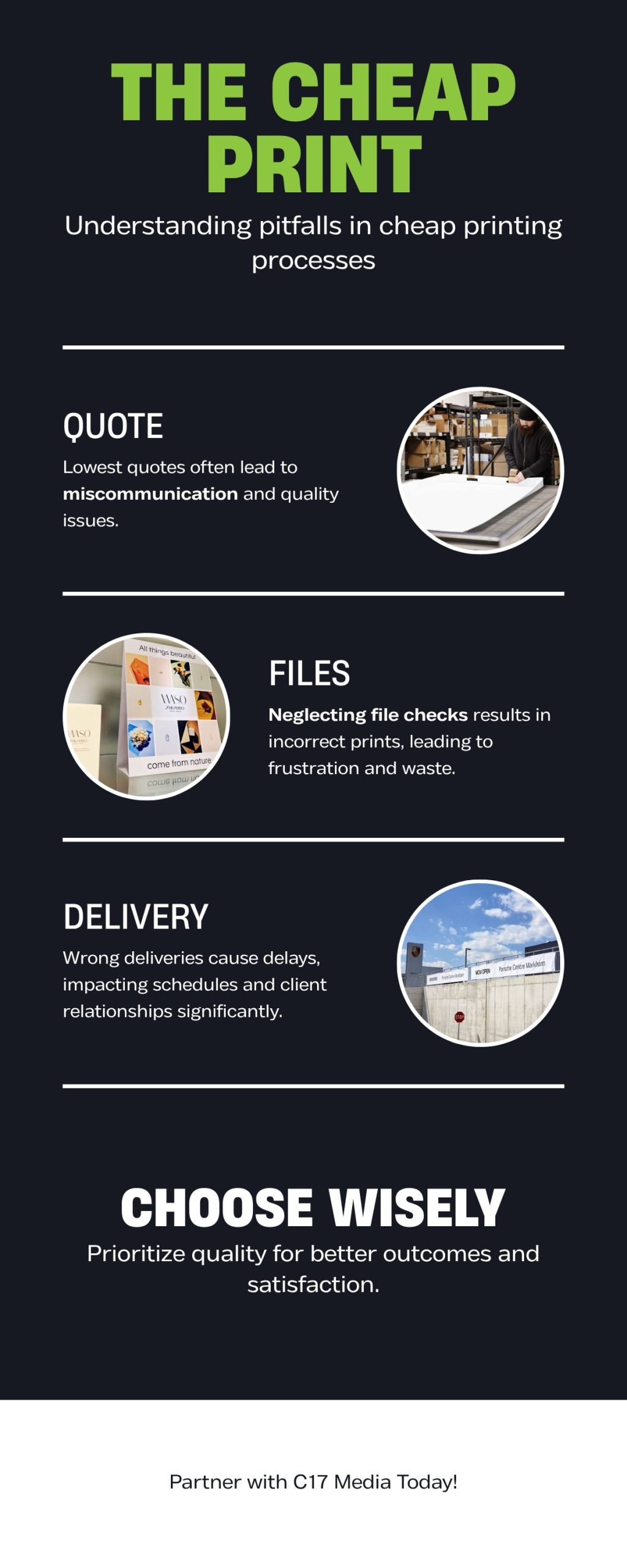
The short answer: everything that protects you when something goes wrong. Presses, ink, and paper cost roughly what they cost everywhere. When one quote comes in dramatically lower, the savings almost never come from the printing itself. They come from removing the safeguards around it.
Most rock-bottom pricing runs on the gang-run model. Your job gets batched onto a shared press sheet with dozens of strangers’ orders, printed in one pass, trimmed, and shipped. It’s genuinely efficient. It’s also why your brand colour comes out however the batch comes out, and why your stock options are a fixed menu rather than a choice.
Then come the three quiet deletions:
- No preflight. Nobody opens your file before it prints. RGB colour, missing bleed, a low-resolution logo: many portals print all of it exactly as uploaded. We’ve written about why print files fail even after the portal accepts them.
- No real proofing. An automated PDF preview is not a proof. It can’t show you how ink behaves on the actual stock, and it exists mostly so the terms of service can say you approved it.
- No recourse. When the box arrives wrong, there’s no account manager who knows your job. There’s a ticket queue, a reprint policy written by lawyers, and a deadline that doesn’t care about either.
You weren’t quoted a lower price for the same product. You were quoted a different product with the safety equipment removed. Our guide on how to choose a print shop in Toronto covers the questions that expose the difference in minutes, or you can book a complimentary consultation and we’ll show you exactly where quotes diverge.
The Triple Cost: The Job, the Redo, the Credibility
Here’s the accounting the low quote never shows you. When a cheap job fails, you don’t lose one print budget. You lose three things, and only the first one appears on an invoice.
Cost one: the job itself. The failed run is money spent on material you can’t use. Whatever you saved against the better quote is gone, along with everything else you paid.
Cost two: the redo. The reprint usually happens at a proper shop anyway, at normal pricing, on a compressed timeline, sometimes with rush freight. You end up paying for the job twice and getting it once.
Cost three: your credibility. This is the expensive one. Somebody inside your company wears every print failure, and it’s rarely the printer. It’s the marketing manager who picked the vendor. The franchise ops lead who signed off. The GM who promised the date. And if the flawed piece actually reaches customers, the damage compounds: in a US FedEx Office survey, 68% of consumers said they believe a business’s signage reflects the quality of its products or services, and 52% said they were less willing to enter a store with poorly made signs (FedEx Office/Ketchum, 2012). A cracked fold or a drifted brand colour isn’t neutral. It’s a message, and you didn’t approve it.
That’s the cheap-print spiral in full: the low quote creates the failure, the failure creates the reprint, and the reprint creates the meeting where you explain both.
When Is Cheap Printing Actually the Right Call?
Sometimes, and it’s worth being honest about that. If the piece is generic, short-lived, and forgiving, an online portal is a perfectly rational purchase. Plain postcards for a weekend event. Internal flyers nobody outside the building will see. In those cases colour drift genuinely doesn’t matter, and paying for preflight and proofing would be buying insurance on something with nothing to insure.
The honest test is a single question: whose name is attached to the outcome? If the answer is “nobody’s, really,” go cheap with a clear conscience. If the answer is you, your brand, or a date you promised somebody upstairs, the calculation changes completely. Deadline-critical launches, colour-critical brand pieces, anything a customer will hold and judge: those jobs carry consequences, and consequences are exactly what the low quote doesn’t cover.
The mistake isn’t using cheap printing. The mistake is using it for work that can hurt you.
How Does One Accountable Shop Break the Spiral?
By removing the handoffs where jobs go to die. Every step in the cheap-print spiral depends on nobody being responsible: no human at preflight, no proof against real targets, no person to call when the box is wrong. Put one accountable team around the whole job and the spiral has nowhere to start.
Here’s what that looks like in practice at C17 Media. Every project runs through our 15,000 square foot facility in Richmond Hill, where digital and offset presses operate alongside large format printing under one roof. A person opens your files before anything prints. Proofs get checked against your brand targets, not against whatever the batch produces; if consistency across pieces is your particular headache, we’ve covered why brand colours drift in printing and how a colour-managed shop prevents it. And because we produce both processes in-house, our advice on which one fits your job is honest. Our digital vs. offset comparison lays out where each wins.
Does that cost more than the cheapest portal? Usually, yes. But you’re not paying extra for the same product. You’re paying for the version where somebody catches the error on Tuesday instead of you discovering it Thursday, and where “who’s responsible?” has exactly one answer with a phone number.
Proof Under Pressure: Porsche Centre Markham
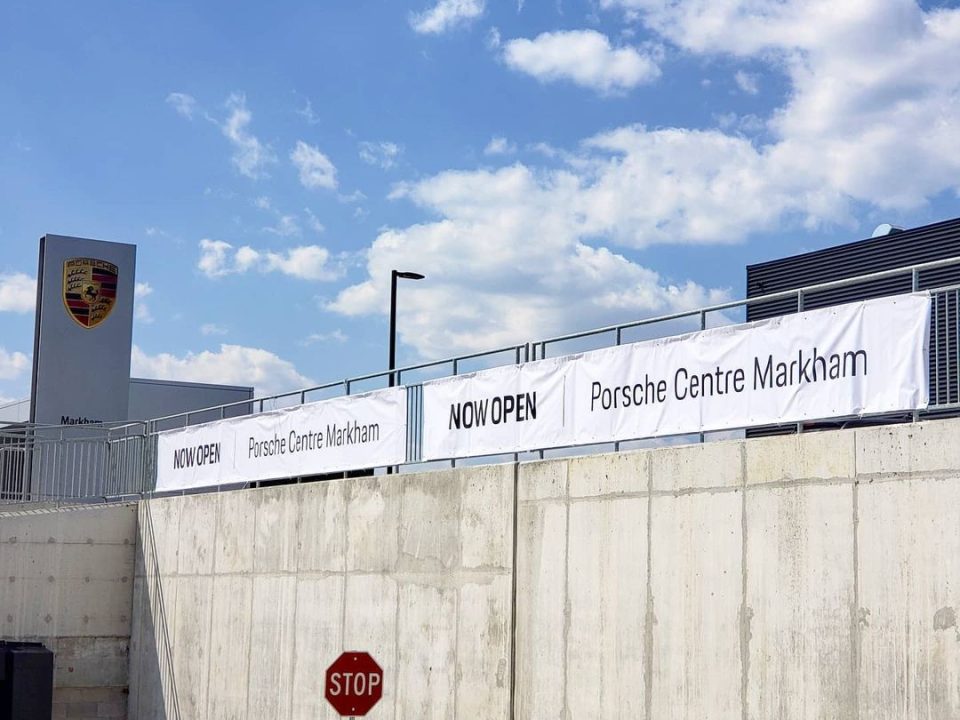
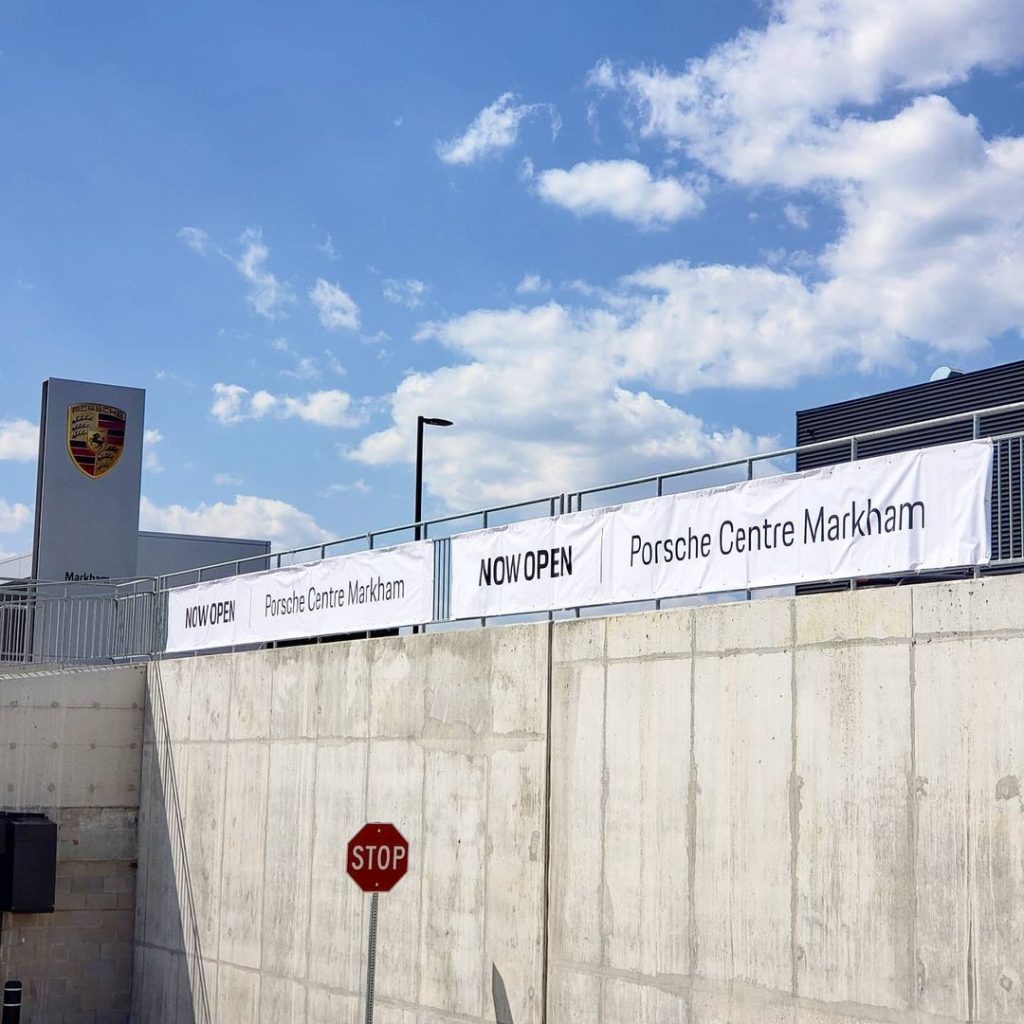
Claims are easy, so here’s a checkable one. When Porsche Centre Markham was built, C17 Media was involved while the dealership was still architectural drawings. We produced and installed the showroom fabric displays, the drive-thru graphics, the window frosting required under Ontario Building Code, and the signage the building needed for municipal occupancy approval. Then came the piece that matters here: the opening-day stationery program. Business cards, service forms, sales folders, everything each department needed from the first morning the doors opened.
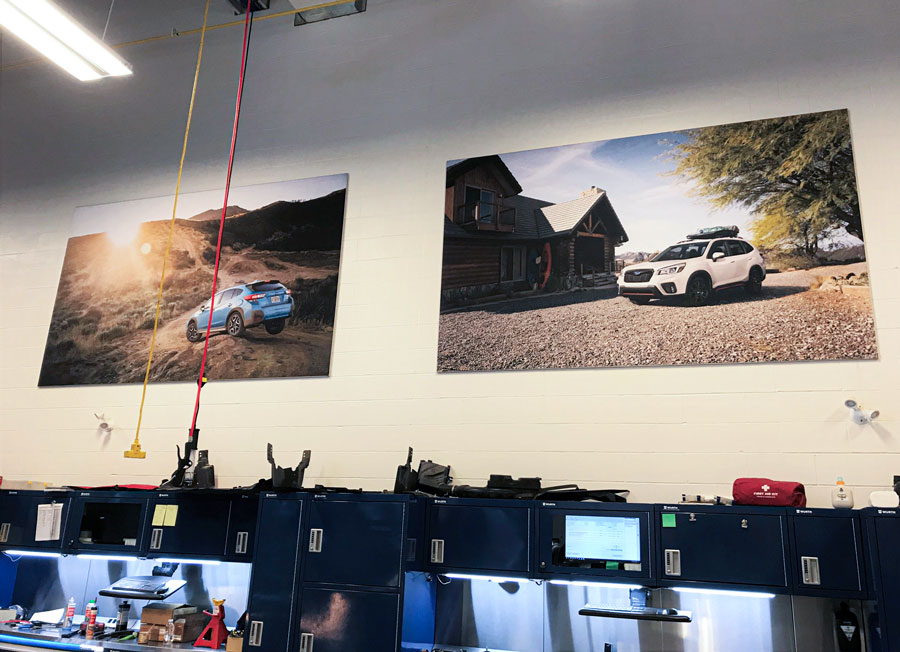
An opening day is the purest deadline-critical job. There is no second opening day, and nobody chasing that date shops the bottom of the quote pile. The full Porsche Centre Markham project is on our portfolio, alongside sixteen years of work for more than 40 recognized brands, including Shopify and Hudson’s Bay. Browse the rest of our work and judge for yourself. None of it means we’re perfect. It means the people handling your deadline have handled ones with no margin at all.
Frequently Asked Questions About Cheap Printing
Why is online printing so much cheaper?
Mostly gang-run economics: your job shares a press sheet, ink settings, and a fixed stock menu with dozens of other orders, and human review is removed entirely. The efficiency is real. So are the trade-offs in colour control and recourse.
What is preflight, and why should I care?
Preflight is a human review of your files before production: colour mode, bleed, resolution, fonts, and dimensions. It matters because upload portals routinely accept and print flawed files. Preflight catches the mistake while it’s still free to fix, not after it’s printed a few thousand times.
Is cheap printing ever the smart choice?
Yes. Generic, short-lived, low-stakes pieces suit online portals well, and pretending otherwise would be dishonest. The line to draw is accountability: if a failure would cost you a deadline, a customer impression, or an awkward conversation upstairs, the job belongs with a shop that checks the work.
Does print quality really affect how customers see my business?
Customers read craftsmanship as competence, and the research earlier in this guide backs that up. A flawed printed piece makes the quality judgment for them before you get the chance to speak, and it keeps making it every time someone picks the piece up.
Is print still worth serious budget in 2026?
Yes. Smithers forecast the global print market at $834.3 billion in 2026, with digital printing’s share of that value growing from 17.2% in 2021 to 21.6% (Smithers, 2021). Businesses keep investing because physical print keeps earning attention and trust that screens don’t replicate.
What should I ask before accepting a very low quote?
Three things: will a person preflight my files, how will I proof colour, and who do I call if the job arrives wrong? A shop that answers all three specifically has earned its price. A shop that can’t has just explained its discount. Our print shop buyer’s guide covers the full interview.
If my file has problems, whose job is it to catch them?
Legally, the fine print usually says yours. Practically, a good commercial shop treats file-checking as part of the service, because printing a known error helps nobody. The most common failures, from RGB colour to missing bleed, are covered in our post on why print files fail.
The Math, Done Honestly
Cheap printing isn’t a scam. It’s a product with the protections removed, sold to people who often don’t realize what was taken out. For jobs with no consequences, that trade is fine. For the campaign with a date, the piece customers will hold, the launch your director is watching: the cheapest quote is routinely the most expensive line on the project, because it gets paid three times.
C17 Media has printed for GTA businesses since 2010: digital, offset, and large format produced by one accountable team in one Richmond Hill facility, with a human checking every file before a press touches it. Book a complimentary consultation through our contact page, call 905-597-2178, or email hello@c17media.com, Monday to Friday, 9:00 to 5:30. Send us the quote that looks too good to be true. We’ll show you exactly what it leaves out, and you can decide with the full picture in front of you.